Your next adventure could be a moment together.
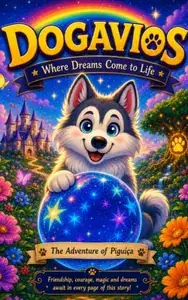
Now that you have met Pigúiça here, discover the story behind her world. See the illustrations, read the beginning and choose a book to share with your child, one page at a time.
Looking for math jokes for kids that are truly funny and help take the fear out of numbers? Here are 25 clean ones about sums, shapes, times tables and even math teachers. Kids from 5 to 10 get them, giggle, and immediately want to tell the whole class at recess.
The 25 math jokes
- Why was the math book sad? It had too many problems.
- What did zero say to eight? Nice belt!
- Why did the student bring a ladder to math class? To reach a higher level.
- Why is the circle so calm? It has no corners to get stressed about.
- What did the circle say to the square? I like you, but you are a little too square.
- Why does the math teacher never get lost? The teacher always finds the straightest path.
- Why is zero so modest? Alone it is worth nothing, but next to a one it becomes ten.
- What is a pirate's favorite number? Seven, because of the seven seas.
- Why is the clock good at math? It is always counting the seconds.
- What did the fraction say to the pizza? I have my eye on your slice!
- How many paws does Pigúiça have? Four. And if she lifts one? Still four, but one is in the air!
- What is Fofuxo plus Pigúiça? Two friends and lots of play.
- Why did the pencil do badly on the math test? It got rubbed out right when it was time to add.
- Why did the eight lie down? To become infinity and rest forever.
- Why can the triangle never lie? All its sides are in plain sight.
- Why does the rectangle love the movies? The screen has the same shape as it does.
- If you have five candies and give two to a friend, what is left? A happy friend!
- Why does the cube never roll down the hill? It has too many corners to hold onto.
- Why did the math teacher bring a plant to class? It had a lot of roots.
- Why is an even number so kind? It always knows how to share with a friend.
- Why does the student love counting sheep? It is the only sum that makes you sleepy.
- Why is the plus sign so cheerful? It only thinks about bringing friends together.
- Why is the thermometer good at math? It has lots of degrees.
- Why does the ruler never make mistakes? It always measures its words.
- Why does the student like the tens table? You just add a zero at the end and you are done.
How to tell a joke to a kid
Good timing is half the fun. These tips work with every joke on the list.
Ask the question, then wait. Let your child try to guess before you give the punchline. Even a wrong guess gets a laugh.
Go slow and make a face. Lower your voice on the question, lift it on the answer. A two-second pause makes any joke better.
Let them tell it too. When a child learns a joke, they repeat it ten times. That builds memory, vocabulary and the confidence to speak up.
Explain the wordplay gently. In jokes like the one about roots or degrees, one word has two meanings. Showing that is a playful way to teach language and math at the same time.
Matching jokes to ages
For little ones aged 5 and 6, pick simple jokes with shapes and numbers, like the calm circle and zero meeting eight. For ages 7 and 8, add the wordplay, like problems, roots and degrees. From age 9, kids love inventing their own jokes, and math gives them endless ideas.
Want more giggles? Try our short jokes for kids and riddles for kids with answers. After the laughs, how about a game? Pigúiça, the blue-eyed husky from the Dogavios book, has a free game in the browser, with no sign-up and no ads. And to practice spotting shapes, hand them some free printable coloring pages and ask them to find circles, squares and triangles in every picture.
A fun family idea
Host a «math joke show» at home. Everyone picks a joke, practices, and performs it for the family. Whoever wants can draw the number or shape from the joke on a sheet of paper and show it at the punchline. Group play, always with a grown-up nearby, makes the evening lighter and full of laughter.
Another idea is a «joke of the day» at breakfast or on the way to school. It is a simple way to start the morning in a good mood, and your child will start hunting for new jokes to bring back. Write the favorites in a little notebook and, at the end of the month, hold a family vote to crown the champion.
Laughing at math also helps kids who feel nervous about it. When numbers become linked to something fun, homework time gets lighter, and the teacher says thank you.
Frequently asked questions
At what age do kids understand math jokes?
Most kids get simple jokes about shapes and numbers from age 5. Wordplay with double meanings, like roots and degrees, usually clicks around age 7 or 8.
What if my child doesn't find it funny?
That's fine. Switch jokes, change your voice, or let your child invent a silly answer. Laughing together matters more than landing the punchline.
Can I use these jokes in the classroom?
Yes. They are all clean and short, perfect for opening a math lesson, a circle time or a break.
Your next adventure could be a moment together.
Now that you have met Pigúiça here, discover the story behind her world. See the illustrations, read the beginning and choose a book to share with your child, one page at a time.
Your next adventure could be a moment together.
Now that you have met Pigúiça here, discover the story behind her world. See the illustrations, read the beginning and choose a book to share with your child, one page at a time.