Your next adventure could be a moment together.
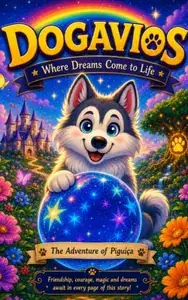
Now that you have met Pigúiça here, discover the story behind her world. See the illustrations, read the beginning and choose a book to share with your child, one page at a time.
Who wins: Velociraptor or a chicken? T. rex or a cheetah? Here are 12 dinosaur showdowns, each with a short, fun answer that stays careful with the science. When scientists are not sure, we say so plainly, because saying “we do not know yet” is learning too. Perfect for kids aged 3 to 8 to vote first and then find out the result.
Racing showdowns
- Velociraptor vs. chicken: who wins the race? Probably the Velociraptor. It had feathers, light legs and was about the size of a turkey, and scientists think it ran quite fast. A chicken is quick off the mark too, so it would be a lively race.
- T. rex vs. cheetah: who wins the race? The cheetah, no question. It is the fastest land animal alive today. Scientists think T. rex could walk fast, but was too heavy to sprint like a racing champion.
Notice that the most famous dinosaur does not always win. In nature every animal is good at something, which makes for a great chat with your child.
Strength showdowns
- T. rex vs. crocodile: who has the stronger bite? Scientists think T. rex, which had one of the strongest bites of any land animal that ever lived. Crocodiles have a mighty bite too, so this is a duel worth respecting.
- Ankylosaurus vs. armadillo: who has the toughest armor? The Ankylosaurus. Its body was covered in hard plates and it even had a club on its tail. The armadillo protects itself well, but it is much smaller.
- Pachycephalosaurus vs. ram: who wins the headbutt? A tie of stubbornness! Pachycephalosaurus had a very thick skull top, and scientists still debate whether it really headbutted. Rams headbutt for sure, that we know.
Size showdowns
- Triceratops vs. T. rex: who is bigger? Almost a tie, since both were giants. Scientists think T. rex was a little longer, while Triceratops was very sturdy, with three horns and a bony frill on its head.
- Brachiosaurus vs. giraffe: who is taller? Brachiosaurus, by far. It had a long neck and lifted its head much higher than a giraffe, the tallest animal alive today.
- Blue whale vs. Argentinosaurus: who is bigger? The blue whale. Scientists think it is the biggest animal that ever lived, even bigger than the giant dinosaurs. And it lives in the sea, right here with us.
Flying showdowns
- Hummingbird vs. Microraptor: who flies better? The hummingbird, which can hover in place and even fly backwards. Microraptor had feathers on its arms and legs, like four wings, and scientists think it glided between trees. Fun fact: birds, hummingbirds included, are dinosaurs that are still alive today.
- Quetzalcoatlus vs. albatross: who has the bigger wings? Quetzalcoatlus, which was a pterosaur, a relative of the dinosaurs but not a dinosaur itself. It was one of the biggest flying animals of all time, with wings much larger than an albatross, which today has one of the biggest wingspans among birds.
Water showdowns
- Spinosaurus vs. crocodile: who swims better? Scientists think Spinosaurus spent plenty of time in the water and fished, but they still debate how well it swam. Crocodiles are born swimmers, so call it a tie with a question mark.
- Mosasaurus vs. great white shark: who is bigger? Mosasaurus, which was a marine reptile and not a dinosaur. Scientists think it was much bigger than a great white shark. Today the shark rules the blue sea, but Mosasaurus wins on size.
How to play the voting game with your child
Before reading each answer, read only the question and ask your child to vote. They can raise a hand, point to a side, or drop a paper pebble in one of two cups. Then read the answer together and count points: one for a right guess, and a cheer for anyone who learned something new.
Let your child invent a duel too: “Who wins, the dog or the Velociraptor?” If they cannot say why they voted, ask: “Why did you pick that one?” What matters is the thinking, not the score.
Whenever the answer is “scientists think,” take the chance to show that science can say “we do not know yet” and keep investigating.
After the showdowns: play and color
Want to keep the fun going? Your child can play Pigúiça’s free game in the browser, with no sign-up and no ads, or print a coloring page and paint the winner of your vote. To meet the gang from the Magic Garden, read who Pigúiça is, the blue-eyed husky who loves questions.
In the book Dogavios, Pigúiça and Fofuxo are always asking curious questions too, and curiosity is the best way to start an adventure.
Frequently asked questions
What ages are these showdowns for?
They work well from 3 to 8 years old. Little ones enjoy the animals and the voting, and older kids like explaining the answer to their parents.
Are all these dinosaurs real?
Yes, they all existed. But scientists are still discovering things, so we say “scientists think” when nothing is certain. Two of the animals, Quetzalcoatlus and Mosasaurus, were not dinosaurs, and that is a good chat too.
What if my child wants to change their vote?
Go for it, that is great! Changing your mind after thinking harder is a scientist’s skill. Let your child explain what made them change.
Your next adventure could be a moment together.
Now that you have met Pigúiça here, discover the story behind her world. See the illustrations, read the beginning and choose a book to share with your child, one page at a time.