Your next adventure could be a moment together.
Now that you have met Pigúiça here, discover the story behind her world. See the illustrations, read the beginning and choose a book to share with your child, one page at a time.
Why does the Moon change shape? Why do astronauts float? What is a black hole? Here are 15 curious questions about space, with short and correct answers in simple words for kids aged 3 to 8. Read one a night or all at once, ideally while looking up at the sky.
The Moon, the Sun and our Earth
- Why does the Moon change shape? The Moon is always round, but we only see the part the Sun lights up. As it travels around the Earth, we see a different part each night: sometimes full, sometimes a thin sliver.
- Is there wind on the Moon? No! The Moon has no air, so there is no wind and no sound. That is why the footprints left by astronauts stay there for a very long time.
- Is the Sun a star? Yes! The Sun is a star, the closest one to us. It looks huge and warm because it is so much nearer than the other stars in the sky.
- Can I look straight at the Sun? Never! Sunlight is so strong that it hurts your eyes, even with ordinary sunglasses. We enjoy its light without staring at it.
- Why does the Sun disappear at night? It does not. The Earth spins slowly like a top, and at night our side faces away from the Sun. On the other side of the world, it is daytime.
Planets and stars
- How many planets are in the Solar System? Eight, and they all travel around the Sun: Mercury, Venus, Earth, Mars, Jupiter, Saturn, Uranus and Neptune. Earth is the third one counting from the Sun.
- Which planet is the biggest? Jupiter! It is a giant ball of gas, so big that many Earths would fit inside it.
- What are Saturn’s rings made of? Pieces of ice and rock of many different sizes. They spin around the planet like a skating rink in space.
- Which planet is the hottest? Venus. It has a very thick blanket of air that traps the Sun’s heat, so it is even hotter than Mercury, which is closer to the Sun.
- Why is Mars red? Because its ground is covered in dusty rust, the same stuff you see on an old nail. That is why it is nicknamed the red planet.
- Why do stars shine? They are giant balls of very hot gas that make their own light. They look tiny only because they are very, very far away.
- Why do stars seem to twinkle? Their light passes through the Earth’s air, which is always moving. It is like looking at a coin at the bottom of a pool with ripples: the picture seems to wobble.
Astronauts and black holes
- Why do astronauts float? Earth’s gravity still pulls on them, but the spaceship and the astronauts are always falling around the planet together. That is why they feel weightless and float inside.
- How do astronauts sleep? They sleep inside a sleeping bag attached to the wall. If they were not attached, they would drift around the ship while they slept.
- What is a black hole? It is a place in space with gravity so strong that not even light can get out. Black holes are very, very far from Earth, so they are no danger to us.
How to talk about space with your child
Curious questions work best when the conversation keeps going after the answer. Ask: “If you were an astronaut, which planet would you visit?” or “What would you pack in your spaceship backpack?” Kids use their imagination and remember the fact more easily.
On clear nights, look for the Moon and the stars from a window or the backyard. You can notice whether the Moon looks bigger or smaller than last week and talk about what changed. Always remember: never look at the Sun, and any outing at night happens with a grown-up close by.
Nobody has to memorize anything. The goal is to build the habit of asking, and the answers get better with time. If your child repeats the same question several nights in a row, great: repeating is how kids learn and feel safe enough to ask again without fear of being wrong.
Family game: guess before you read
Before reading each answer, ask your child to guess. A right guess earns a cheer, and a wrong one is a fun new discovery with no pressure. Afterwards, play Pigúiça’s free game or print a coloring page and paint a planet with rings any way your child likes. If your little one loves stories, the free cartoons about the Magic Garden gang make great conversation too.
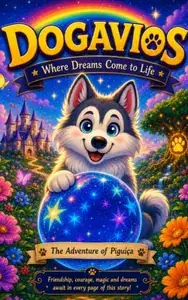
In the book Dogavios, Pigúiça and Fofuxo are always asking questions too, and curiosity is the best way to start an adventure.
Frequently asked questions
What ages are these questions for?
They work well from 3 to 8 years old. Little ones love the Moon, the Sun and the stars, and older kids enjoy explaining the answer to their parents.
What if my child asks something I do not know?
It is fine to say: “I do not know, let’s find out together.” Looking up the answer in a book with your child is a great lesson too.
Can I use these questions in a classroom?
Yes. Each question makes a short chat and fits a circle of curiosities before a drawing activity.
Your next adventure could be a moment together.
Now that you have met Pigúiça here, discover the story behind her world. See the illustrations, read the beginning and choose a book to share with your child, one page at a time.