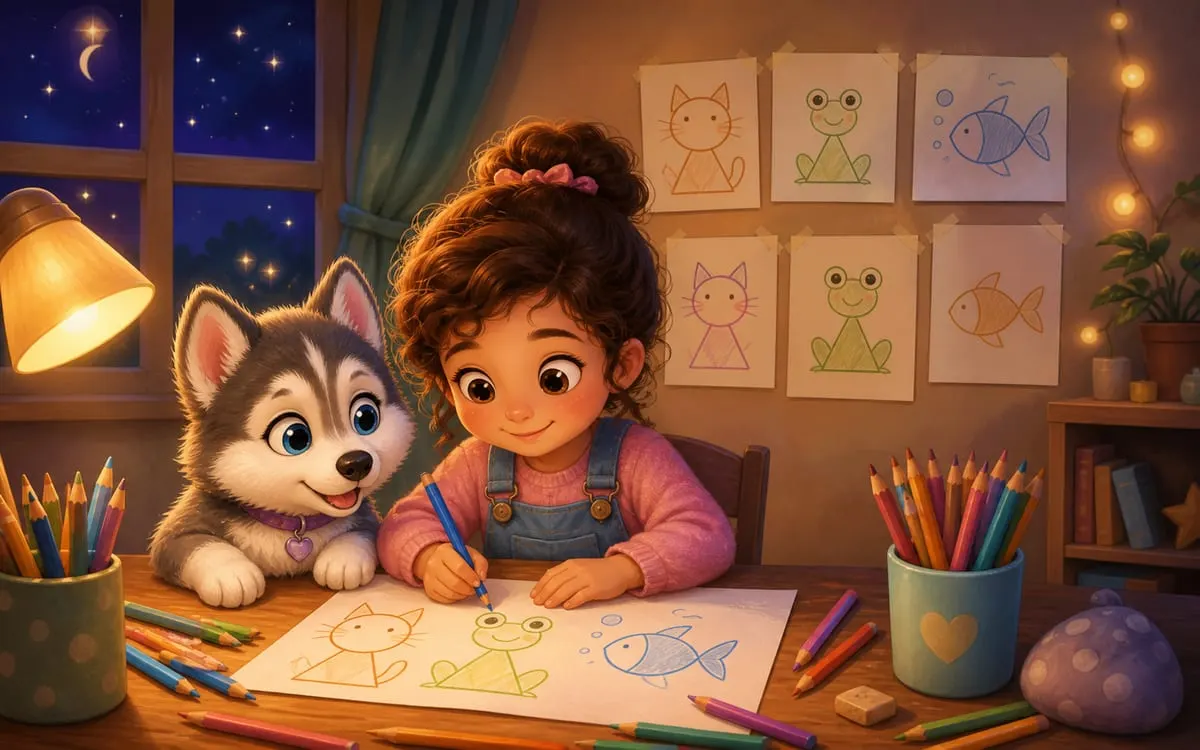
Your next adventure could be a moment together.
Now that you have met Pigúiça here, discover the story behind her world. See the illustrations, read the beginning and choose a book to share with your child, one page at a time.
To draw an easy dinosaur, start with a big oval for the body, add a long curved neck up to a small circle for the head, give it four chunky rectangle legs and finish with a tail shaped like a stretched teardrop. That is the whole thing in 6 steps, using only shapes children already know. Below you will find the full walkthrough, designed for kids aged 4 to 8 drawing alongside a grown up.
What you need
A sheet of white paper, a soft pencil, an eraser and some colored pencils or crayons. For 4 and 5 year olds, a bigger sheet and a chunky pencil make everything easier to control. Tell them to draw lightly at first, because the extra lines will be erased later.
A cute long neck dinosaur in 6 steps
This is a friendly, Brachiosaurus style dinosaur with a smiley face. Draw each step on your own paper while your child draws on theirs, so they copy the movement and not just the finished picture.
- The body: draw a big oval lying on its side in the middle of the page, slightly low. It looks like an egg on its side or a potato.
- The head: near the top right of the page, draw a small circle, about the size of a coin. Leave plenty of space between it and the body.
- The neck: connect the head to the body with two parallel curved lines, like a slide at the playground. The lower line meets the front of the body, the upper one joins a little further back.
- The tail: on the other side of the oval, draw two lines that come together in a point. The shape looks like a stretched teardrop or a carrot.
- The legs: under the body, draw four short, chubby rectangles, two at the front and two at the back. Close each one with a flat line for the ground and three little marks for toenails.
- Face and details: add a big dot for the eye with a white shine, a curved smile and two tiny nostrils. Finally, erase the lines left inside the body and trace the outline more firmly.
Done: a complete dinosaur made from an oval, a circle, a few lines and some rectangles. If your child enjoys drawing with shapes, our step by step cat works the same way and makes a great next project.
Variations: three famous dinosaurs from the same shapes
Once the first dinosaur is on paper, kids quickly notice that changing one or two shapes creates a whole new species. That is where drawing turns into discovery.
T. rex
Tilt the body oval so the front sits higher. Swap the round head for a large rectangle with rounded corners, a long mouth and zigzag teeth. It stands on its two thick back legs only and gets two tiny arms, just two short strokes. The teardrop tail stays, but points straight back for balance.
Triceratops
Keep the flat oval body and four short legs, but skip most of the neck. The head is a rounded triangle facing forward, with a big half circle behind it like a fan or a collar. Finish with three horns: two long triangles above the eyes and a small one on the nose.
Stegosaurus
Here the body is a taller oval, almost an arch. The head is tiny and low, close to the ground. Along the back, draw a row of triangles or diamonds, big in the middle and small at each end. At the tip of the tail, add four short spikes. Wondering why it had those plates? Share a few dinosaur facts for kids while your child draws.
Coloring tips
Nobody knows for sure what color most dinosaurs were, which is fantastic news for young artists: anything goes. Green and brown are classics, but purple with yellow spots is a perfectly good dinosaur too.
- Color the belly a lighter shade than the rest of the body. It adds instant volume.
- Spots, stripes or dots on the back make the drawing more fun and hide small mistakes.
- Stegosaurus plates and Triceratops horns look great in orange or yellow against the body.
- A green ground, a volcano in the back and a sun finish the scene in a few minutes.
No paper handy? Kids can color on screen with our online painting page, and on slower days there are free printable coloring pages ready to go.
Common mistakes and quick fixes
- Head too big: on a long neck dinosaur the head is much smaller than the body. If it came out huge, call it a baby dinosaur and move on.
- Neck as thin as a string: the two lines need space between them. Show the width with two fingers.
- Skinny legs: dinosaurs are heavy. Chubby legs keep the drawing standing firmly.
- Pressing hard from the start: a light sketch is the secret. Only the final outline gets dark.
- Chasing perfection: a wobbly dinosaur is still a dinosaur. Praise the effort, not the result.
Turn the drawing into a game
A finished drawing can easily buy you another half hour of fun:
- Mystery dino: a grown up draws only steps 1 and 2 and the child guesses which dinosaur will appear.
- Dinosaur family: draw a big one, a medium one and a baby, and give each a name.
- Puppet show: cut the dinosaur out (with an adult handling the scissors) and tape it to a craft stick to act out a story.
- Invent a dinosaur: mix parts. A Triceratops head with Stegosaurus plates becomes a brand new species, and your child picks the name.
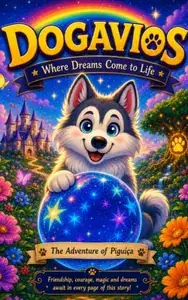
In the Dogavios book, Pigúiça has adventures in the Magic Garden, where imagination rules. A friendly dinosaur wandering through it is a lovely idea for the next drawing.
Frequently asked questions
At what age can a child draw a dinosaur alone?
Around age 4, most children can make circles and ovals and follow the steps with some help. Between 6 and 8, many kids draw the whole thing on their own after seeing it once.
What is the easiest dinosaur to draw?
The long neck dinosaur, because it uses only simple shapes and looks cute even with wobbly lines. The T. rex is a little harder because of its upright pose and teeth.
How can I help without drawing it for my child?
Draw on your own sheet next to them, one step at a time. They see the movement and make their own version, and you never have to take the pencil out of their hand.
Your next adventure could be a moment together.
Now that you have met Pigúiça here, discover the story behind her world. See the illustrations, read the beginning and choose a book to share with your child, one page at a time.