Your next adventure could be a moment together.
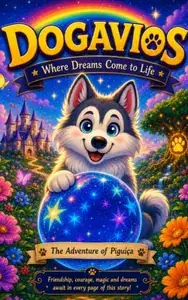
Now that you have met Pigúiça here, discover the story behind her world. See the illustrations, read the beginning and choose a book to share with your child, one page at a time.
Looking for dinosaur facts for kids? Here are 25 true facts, backed by paleontology and written in short sentences you can read aloud with a child aged 3 to 8. Read one each night or all of them on a rainy Sunday. Get ready for a lot of “wow!”.
The giants
- The name means “terrible lizard”. The word dinosaur was coined in 1842 by the English scientist Richard Owen, who put together two ancient Greek words.
- The biggest were the sauropods. These plant eaters had very long necks and tails. Argentinosaurus may have reached about 30 meters (roughly 100 feet), almost three school buses in a row.
- T. rex had teeth the size of bananas. Tyrannosaurus rex grew up to about 12 meters (40 feet) long and had one of the strongest bites of any land animal we know of.
- Brachiosaurus was built like a giant giraffe. Its front legs were longer than its back legs, which lifted its neck high enough to reach leaves at the tops of trees.
- Stegosaurus had a tiny brain. It grew up to about 9 meters (30 feet) long, yet its brain was very small for its body. It carried big plates on its back and sharp spikes on its tail.
The little ones
Not every dinosaur was huge. Some would fit in your backyard without scaring anyone.
- Microraptor had four wings. It was roughly the size of a crow, with long feathers on its arms and on its legs too.
- Compsognathus was about the size of a chicken. It ran fast on two legs and hunted small animals: one fossil was found with a lizard inside its belly.
- The real Velociraptor was small. In movies it looks as tall as a person, but the real animal was about the size of a turkey. And it had feathers!
- The smallest living dinosaur fits in your hand. Since birds are dinosaurs, the record goes to the bee hummingbird from Cuba, about 5 centimeters (2 inches) long.
How they lived
- Most of them ate plants. The majority of known dinosaurs were herbivores. Famous meat eaters like T. rex were actually the minority.
- They were around for a very, very long time. Dinosaurs lived for more than 150 million years, during the Mesozoic Era, which is split into the Triassic, Jurassic and Cretaceous periods.
- T. rex lived closer in time to us than to Stegosaurus. Stegosaurus lived about 80 million years before T. rex. Between T. rex and us, there are about 66 million years.
- People and giant dinosaurs never met. They disappeared many millions of years before the first humans. It happens in cartoons, not in real life.
- Some were caring moms and dads. Many laid eggs in nests. The name Maiasaura means “good mother lizard”, because scientists found nests with babies of this species.
- Some traveled in groups. Scientists have found fossil trackways showing several dinosaurs walking together in the same direction.
- Triceratops had three horns. Two long ones above its eyes and a short one on its nose, plus a huge bony frill behind its head.
- Ankylosaurus was like an armored tank. Its body was covered in bony plates and its tail ended in a heavy club, perfect for defending itself.
Feathers and birds
- Birds come from dinosaurs. That is why scientists call birds living dinosaurs. A backyard chicken is a distant cousin of T. rex!
- Many dinosaurs had feathers. Fossils found in China show feathers preserved in stone on dinosaurs that could not fly.
- We know the colors of a few. By studying microscopic structures in fossil feathers, scientists found that Sinosauropteryx had a striped tail, in reddish orange and white.
- Archaeopteryx had feathers and teeth. It is one of the most famous fossils in the world because it mixes bird and dinosaur features.
- Not every ancient reptile was a dinosaur. Pterosaurs, which flew, and big sea reptiles like plesiosaurs were relatives, but they were not dinosaurs.
How we know all this
- It all starts with fossils. Paleontologists study bones, teeth, footprints, eggs and even fossilized poop, which has a funny name: coprolite.
- A fossil is a stone copy. When an animal was quickly buried in mud or sand, minerals slowly took the place of its bones over time, making a copy in rock.
- Brazil has some of the oldest dinosaurs. In southern Brazil, scientists found some of the earliest dinosaurs known, like Staurikosaurus, from about 230 million years ago.
How to enjoy these facts at home
Make it a game. Read a fact and ask your child to act it out: stomp like Brachiosaurus, dash like Velociraptor, swing a tail like Ankylosaurus. Kids aged 3 to 5 love it, and it burns off energy too.
Use everyday comparisons. School buses, a chicken, a banana. Huge numbers mean little to small children, but familiar things click right away.
Draw together. After reading, pick a favorite dinosaur and follow our step by step guide to drawing a dinosaur. If you want something ready to go, there are plenty of free printable coloring pages.
For kids aged 6 to 8, try a challenge: build a timeline with paper and tape down the hallway, marking Stegosaurus, T. rex and, right at the very end, people. They will see with their own eyes why the T. rex fact is so surprising.
At bedtime, after all that roaring, a calm story helps everyone wind down. The bedtime stories with Pigúiça, the husky pup from the book Dogavios, are short and soothing. And if you have a spare moment on the weekend, the free Pigúiça game runs right in the browser, no sign up needed.
Frequently asked questions
Do dinosaurs still exist?
Yes and no. The giant dinosaurs, like T. rex, died out about 66 million years ago. But birds descend from them and are considered living dinosaurs. So every little bird at your window is a real dinosaur.
What was the biggest dinosaur?
The largest were sauropods like Argentinosaurus, which may have reached about 30 meters. Nobody can be completely sure, because scientists usually find only part of the skeleton and estimate the rest by comparing it with close relatives.
Why did the dinosaurs disappear?
The most accepted explanation is that about 66 million years ago a huge asteroid hit the Earth where Mexico is today. It changed the planet's climate, and massive volcanic eruptions may also have played a part. Many living things vanished, but some small animals survived, including the ancestors of birds.
Your next adventure could be a moment together.
Now that you have met Pigúiça here, discover the story behind her world. See the illustrations, read the beginning and choose a book to share with your child, one page at a time.