Your next adventure could be a moment together.
Now that you have met Pigúiça here, discover the story behind her world. See the illustrations, read the beginning and choose a book to share with your child, one page at a time.
Few things grab attention like the gaze of a Siberian husky. That icy blue seems to glow on its own and sparks the curiosity of almost anyone who sees it. But why do huskies have blue eyes? The answer lies in genetics, and it is more curious than you might expect.
A specific genetic variant
Contrary to what many people assume, the blue in a husky eye does not simply come from a lack of pigment the way it does in some animals. Studies of thousands of dogs link this color to a genetic variant near the ALX4 gene. That small change reduces pigment in the iris and makes the eye scatter light in a way our own eyes perceive as blue.
It is not the merle gene
Here is an important clarification: in huskies, blue eyes are not tied to the merle gene, the one that creates irregular patches in the coat of some breeds. That is exactly why a husky can have bright blue eyes even with a perfectly solid coat, whether black and white or grey. They are completely different genetic mechanisms, which makes husky blue all the more special.
Two different eyes and split eyes
Huskies are famous for heterochromia, when each eye is a different color: one blue and one brown. There is also the parti-colored or split eye, where blue and brown blend within the same eye, creating a one of a kind effect. None of this is a health issue; they are simply beautiful, perfectly natural variations of the breed that give each dog a unique look.
Does the color change over time?
Yes, and this is one of the most fun parts. Almost every husky puppy is born with bluish eyes. Around 5 to 8 weeks of age, the color truly starts to settle. Some stay blue, others shift to brown or amber, and some end up with one eye of each color. Only after a few weeks can you tell the puppy final shade.
Blue does not mean deafness
In certain breeds, blue eyes can be linked to hearing problems. In the husky, that is not the case: their blue eyes have no connection to deafness at all. In other words, that icy blue is pure beauty, with no health risk attached to the color itself.
A quick recap
- The color comes from a genetic variant, not a total absence of pigment;
- It is not linked to the merle gene;
- Heterochromia and split eyes are common and healthy;
- The final color settles in the first weeks of life;
- Blue does not indicate deafness in the breed.
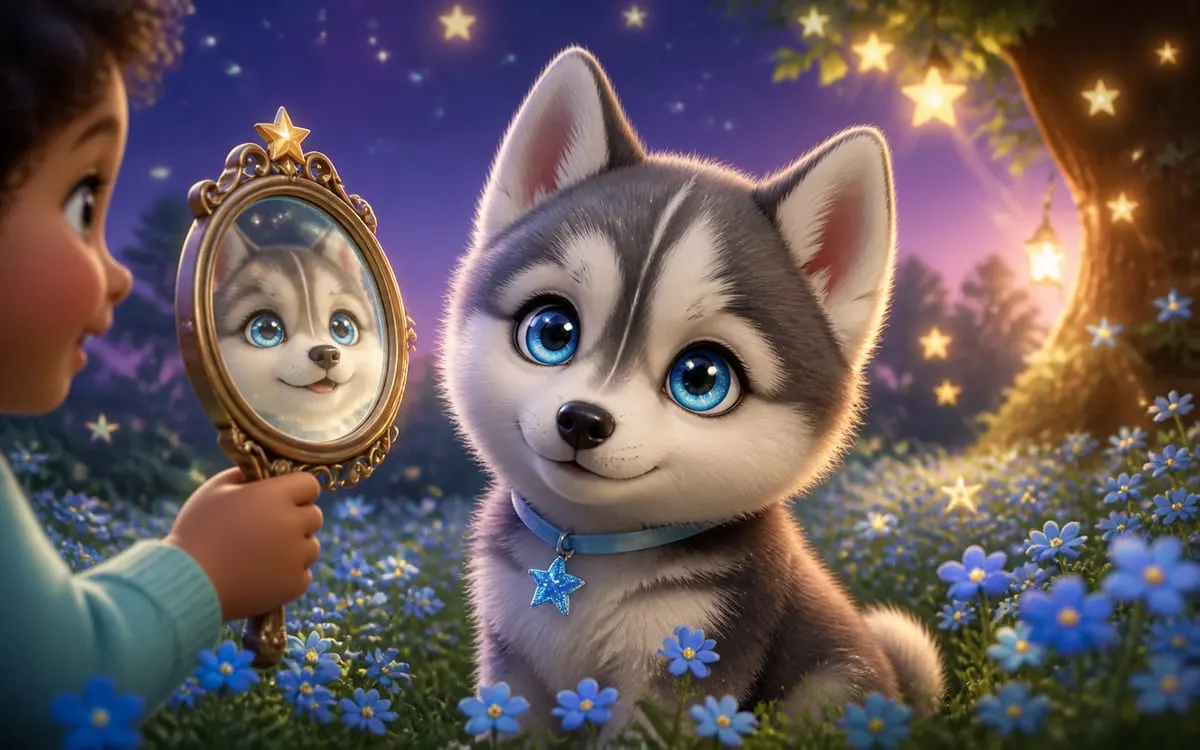
It is worth remembering that eye color, blue or brown, changes nothing about the affectionate personality of the husky. That unmistakable gaze was the perfect inspiration for Pigúiça, the blue-eyed husky puppy of Dogavios who crosses the Magic Garden in an adventure about friendship, courage and dreams. Kids can follow her every step in the free Dogavios game, which runs in the browser in 18 languages.
Your next adventure could be a moment together.
Now that you have met Pigúiça here, discover the story behind her world. See the illustrations, read the beginning and choose a book to share with your child, one page at a time.