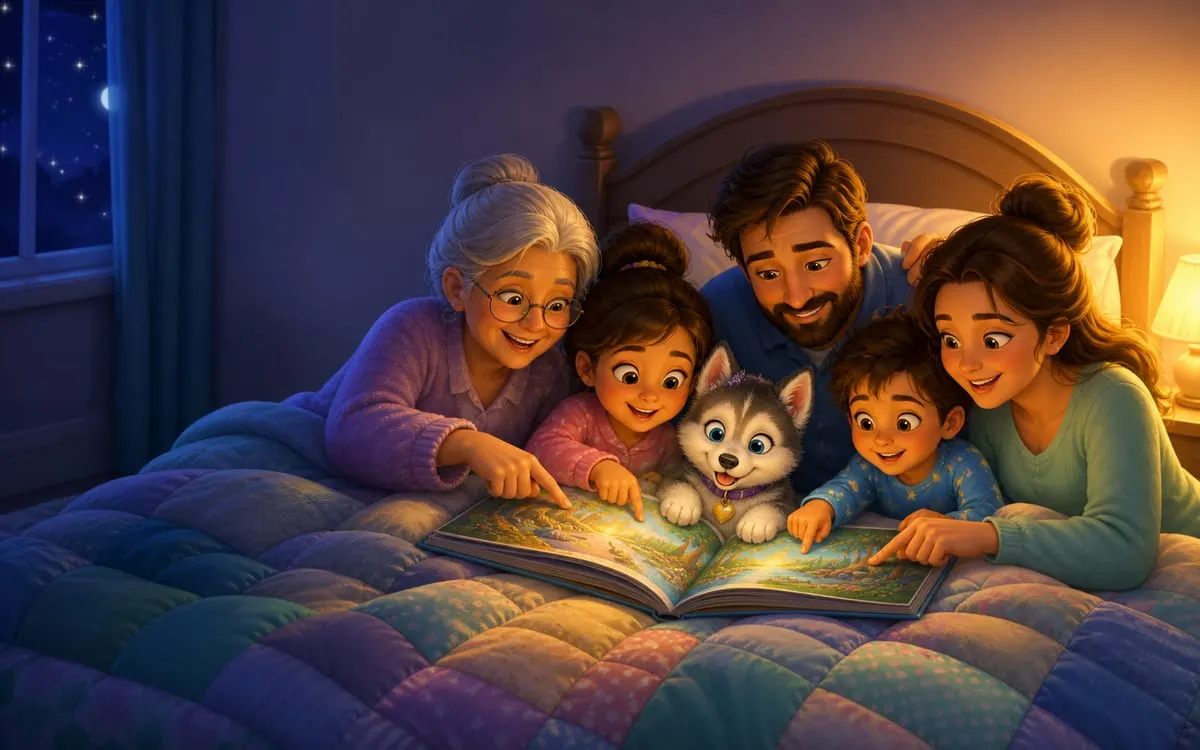
Your next adventure could be a moment together.
Now that you have met Pigúiça here, discover the story behind her world. See the illustrations, read the beginning and choose a book to share with your child, one page at a time.
Everyone knows reading helps vocabulary. What gets discussed far less is what family reading does to the family. That moment with a book open and everyone together has effects that never show up on a report card: it calms, it connects, and it opens a channel of conversation that's hard to open any other way.
What happens beyond vocabulary
- Connection without demands: during reading nobody is correcting behavior, chasing homework or hurrying anyone. It's one of the few moments in the day when simply being together is enough.
- Emotional regulation: when a character feels afraid and your child watches him get through it, she gets a map for her own feelings. Naming an emotion in a story is easier than naming it in your own life.
- Hard conversations sideways: jealousy of a sibling, moving house, a pet dying. Talking about the character is a side door children walk through much more willingly.
- Calmer sleep: reading closes the day at a slower pace with no screen stimulation. Plenty of families solve the bedtime battle with this alone.
- Siblings at different ages: a well-chosen picture book holds a 3-year-old and a 7-year-old at once. Each takes a different layer.
How to make it a real ritual
- Fixed and short: fifteen predictable minutes beat an unpredictable hour. The predictability is what soothes.
- Phone out of the room: if you glance at a screen mid-story, the ritual loses its main ingredient, which is undivided attention.
- Take turns reading: if there's an older child, let her read to the younger one. The pride that generates is enormous.
- Save one question: "what would you have done?" One good question opens a conversation; five close it.
- Include grandparents: by video if they're far away. Reading the same book across distance builds a real bridge.
- Give the adult a turn too: read a paragraph of your own book aloud, even if she doesn't follow all of it. Seeing a grown-up read for pleasure beats any speech about it.
- Don't interrupt to teach: if she wants to talk mid-story, listen. The point of the ritual is togetherness, not reading performance.
Signs it's working
- She quotes the character outside the book: the story has become an internal tool.
- She asks for the same book in a hard week: children seek repetition when they need safety.
- She fetches the book unprompted: the ritual has become hers, not yours.
For a book to spark conversation it needs clear emotions and a conflict your child recognizes. That was the intention behind Dogavios: Pigúiça the husky faces fear, makes friends and finds courage in the Magical Garden, in scenes that almost always pull out a "have you ever felt that?" Since it's in 18 languages on Kindle Unlimited, families with grandparents or relatives abroad can read the same story, each in their own language.
Your next adventure could be a moment together.
Now that you have met Pigúiça here, discover the story behind her world. See the illustrations, read the beginning and choose a book to share with your child, one page at a time.