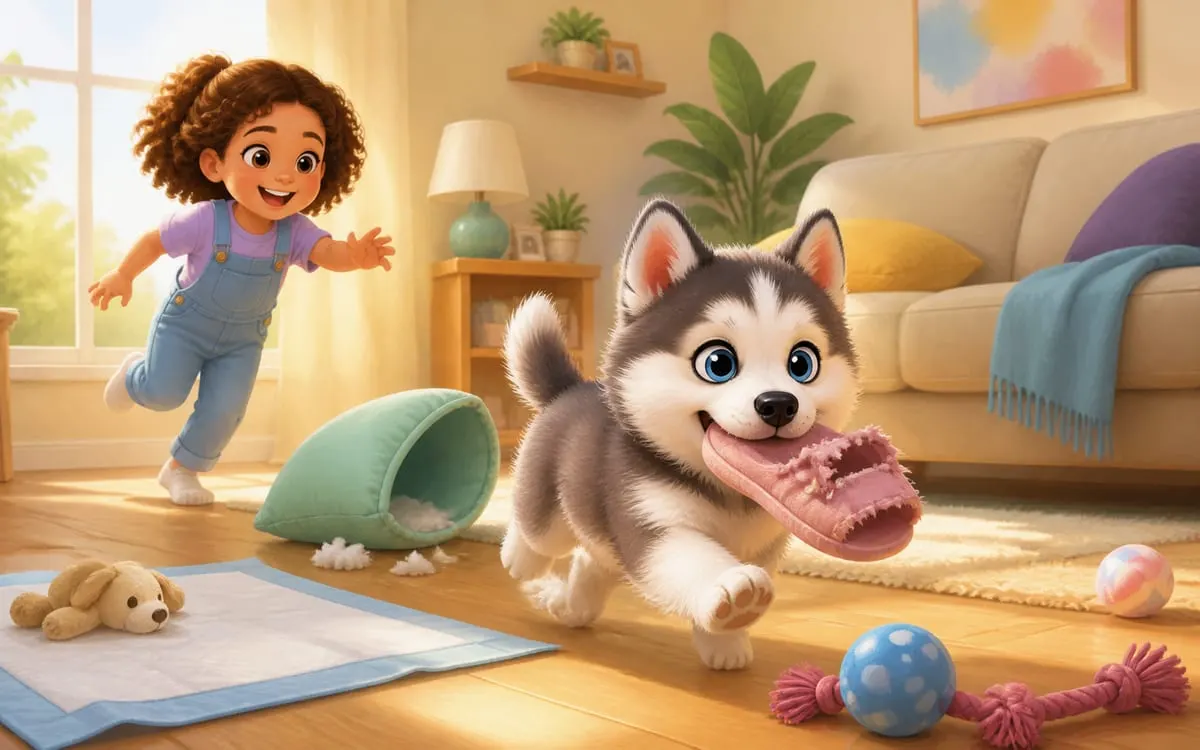
Your next adventure could be a moment together.
Now that you have met Pigúiça here, discover the story behind her world. See the illustrations, read the beginning and choose a book to share with your child, one page at a time.
A husky puppy is one of the most enchanting creatures alive, and one of the most intense. Anyone expecting a sleepy little bundle is in for a shock: high energy, strong opinions, charming stubbornness and a remarkable talent for escaping. None of that is a fault; it is the breed working exactly as it was developed to work. Knowing what is coming changes everything.
Roughly month by month
- 8 to 12 weeks: the golden window for socialisation. Introduce sounds, surfaces, people and new situations in short, positive doses, always following your vet's vaccination guidance.
- 3 to 5 months: teething. He will chew everything, and it is not defiance: it is relief from discomfort. Offer suitable chews and redirect without shouting.
- 5 to 8 months: energy explodes and training seems to evaporate. Keep the rules, shorten the sessions and persist with good humour.
- 8 to 14 months: canine adolescence. He tests limits, ignores recalls and discovers that running off is fun. Leash on, gates checked, patience doubled.
- After one year: he starts to settle, but stays playful for years. Huskies rarely become “quiet” dogs.
Husky quirks that catch people out
- Professional escape artist: digs, jumps and works out latches. High fencing, a reinforced base and a double lock are not overkill.
- Vocal, not barky: he howls, grumbles and “talks”. Charming in a house, a problem in a flat.
- Serious coat blowing: twice a year he sheds undercoat in astonishing volume. Frequent brushing is compulsory.
- Independent: bred to make decisions alone in the snow. That means training built on motivation, never on force.
- Prey drive: cats, chickens and small animals require care and very slow introductions.
What to do from day one
- Predictable routine: fixed times for food, walks and rest reduce anxiety and speed up learning.
- Enforced naps: puppies need a lot of sleep. If he is biting everything and racing in circles, he is probably exhausted rather than bored.
- Short, fun training: five minutes, three times a day, with treats. Huskies get bored of repetition fast.
- Mental work: snuffle mats, stuffed toys and scent games tire him more than a lot of running.
- A vet you trust: vaccines, worming and advice on safe exercise for growing joints.
- Socialise with balanced adult dogs: huskies are sociable by nature, and positive early encounters prevent leash reactivity later.
- Teach alone time gradually: start with seconds and build slowly. A husky who never learned to be alone becomes a full-time howler.
- Brush from puppyhood: make brushing, nail trims and paw handling a calm routine with treats, long before it becomes urgent.
- Never leave the garden unsupervised: a husky puppy digs under fencing with startling efficiency.
If you are considering a husky, consider the adults in shelters too, many end up there precisely because someone underestimated this stage. And if the blue eyes are what started the love affair, the children in your house will adore meeting Pigúiça, the adventurous husky from Dogavios.
Your next adventure could be a moment together.
Now that you have met Pigúiça here, discover the story behind her world. See the illustrations, read the beginning and choose a book to share with your child, one page at a time.