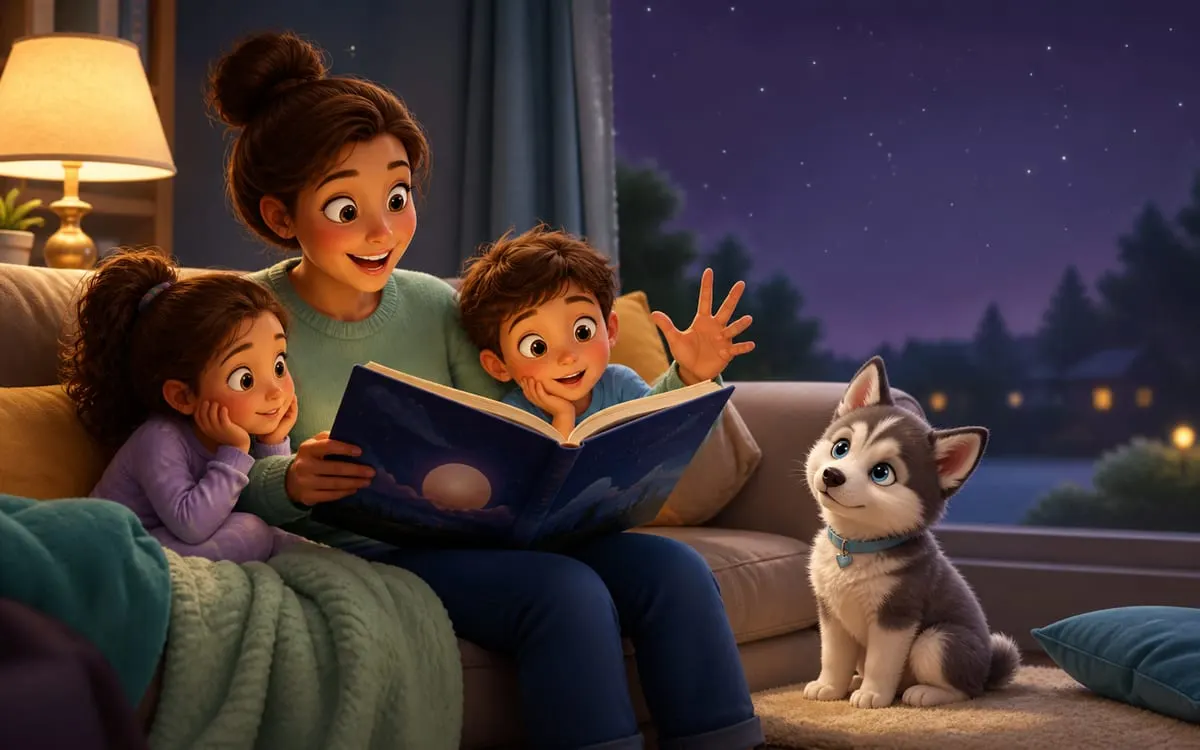

There's a huge gap between reading the words in a book and telling a story. The first makes a child stare at the ceiling; the second glues her to you. The good news: nobody needs acting talent. Reading aloud is a skill you pick up with a handful of very concrete adjustments.
The mechanics: pace, pause, volume
- Read slower than feels natural: most adults rush. Drop about 20% and your child has room to build the pictures in her head.
- Use silence: stop a beat before turning the page. That half-second of suspense beats any funny voice.
- Vary volume, not just tone: whispering grabs far more attention than shouting. If she leaned in to hear you, you've won.
- One voice per character, and keep it: it doesn't have to be good, it has to be consistent. Kids notice when the wolf changes voice and love pointing it out.
How to involve, not just narrate
- Ask before you turn: "what do you think happens next?" Prediction is the engine of comprehension.
- Let her finish sentences: with familiar books, stop mid-line and wait. She'll fill it in and feel like she's reading.
- Point as you read, especially with little ones: your finger shows that text runs left to right and that words have spaces. She learns all that for free, just watching.
- Connect it to her life: "remember when you were scared of the dark, just like her?" The story becomes a mirror, and that's what makes it stick.
- Accept rereading the same book: for the tenth time, yes. Repetition is how kids master vocabulary and structure.
- Let her hold the book: whoever turns the pages owns the story. Worth it even when it wrecks your pacing.
- Talk about the pictures: "look at his face here, how do you think he feels?" Illustrations carry half the story and almost nobody uses them.