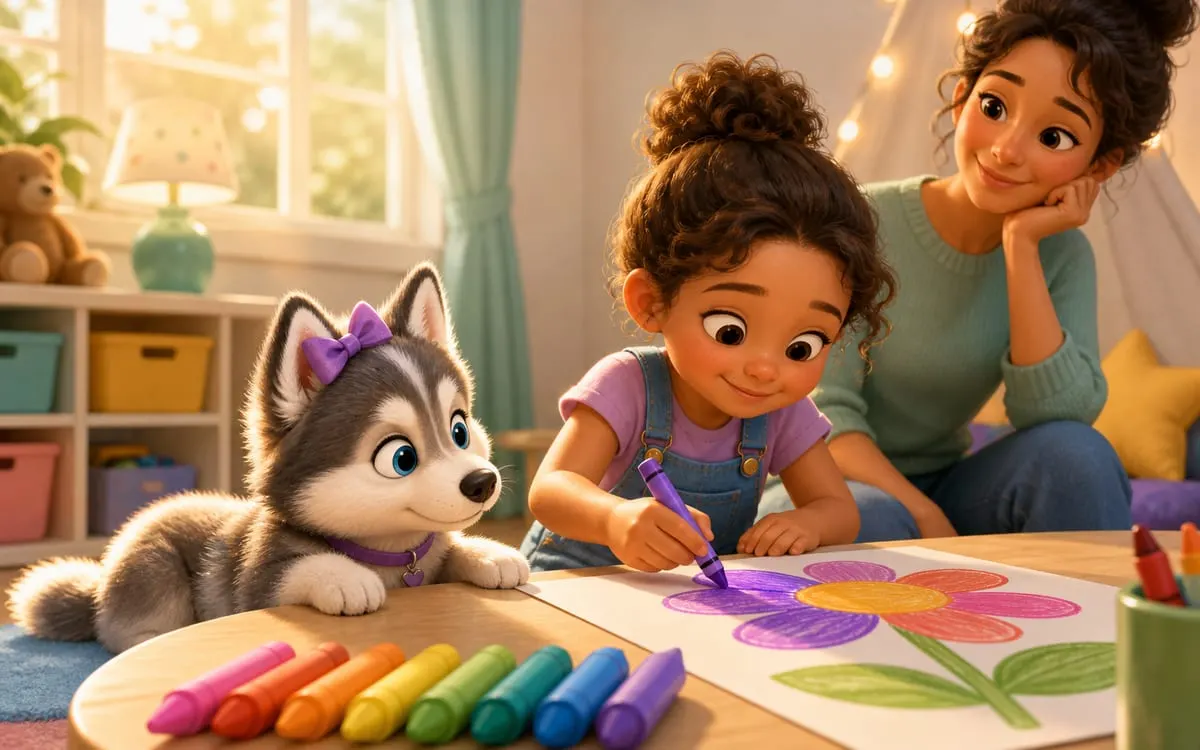

«My kid can't color inside the lines» usually arrives with worry, but the answer is almost always: they are exactly where their age predicts. Staying inside an outline demands fine control of wrist and fingers, and that matures on its own calendar.
What to expect at each age
- 2 to 3: big scribbles that cross everything. Perfect as is, the goal is the joy of the stroke.
- 3 to 4: the child now «aims» at the figure but invades the borders constantly. That is the middle of the road.
- 4 to 5: most strokes stay inside, with escapes at corners and curves.
- 5 to 6: outlines respected on most large figures.
- 6+: precision even in small areas, and the interest shifts to color choices and combinations.
5 tricks that truly help
- Big figure, thick outline: small detailed drawings frustrate any beginner. Start with very thick contours.
- Outline before filling: teach the «train on the tracks» move: first trace just inside the border, slowly, then fill the middle freely. It is the single fastest accelerator.
- Tools sized for the hand: chunky crayons for the little ones, colored pencils from 4, markers once control arrives.
- Tape the paper down: a bit of masking tape frees the hand that was holding the sheet.
- Short sessions: ten good minutes beat forty with a tired hand, and a tired hand smudges everything.
When NOT to push
Never correct a finished picture or color over it «to show how it's done». If the sky came out green and every line was crossed, the training happened anyway, and the next picture improves on its own. Pressure turns crayons into a test, and kids drop tests.
The right paper and figure are half the job
Large figures, thick outlines and one drawing per page with a blank back (markers don't bleed through): that is the recipe of the Dogavios coloring book, starring Pigúiça the husky with 50+ drawings designed for hands ages 2 to 8. You can practice digitally too, coloring online for free. 🖍️