Your next adventure could be a moment together.
Now that you have met Pigúiça here, discover the story behind her world. See the illustrations, read the beginning and choose a book to share with your child, one page at a time.
Looking for food riddles for kids? Here are 20, each with the answer right under the question: seven about fruit, six about vegetables and seven about everyday foods. Read them out loud, let your child think, and only then reveal the answer. They work well at the dinner table, in the supermarket line or in the back seat of the car.
Riddles are a simple, old-fashioned game. Children listen to clues, picture the object and try to reach the answer. When the topic is food, the game has a bonus: kids start paying attention to the color, shape, smell and taste of what is on their plate. That helps a lot with picky eaters.
Fruit riddles
Fruit is a great place to start, because children already know the colors and shapes well. For the youngest, ages 3 and 4, keep the clues easy and show the real fruit after the answer.
- I have a yellow peel, I am long and curved, and monkeys love me. What am I? Answer: a banana.
- I am red outside and pale inside, and they say that whoever eats me every day keeps the doctor away. What am I? Answer: an apple.
- I wear a crown of leaves on my head, but I am not a king. My skin is rough, but inside I am sweet and juicy. What am I? Answer: a pineapple.
- I am green outside, red inside, full of tiny black seeds, and I cool you down on a hot summer day. What am I? Answer: a watermelon.
- I grow in bunches, I am small and purple or green, and I can turn into juice or raisins. What am I? Answer: a grape.
- I am round and orange, but I am not a ball. You squeeze me in the morning and I become juice full of vitamin C. What am I? Answer: an orange.
- I am little and red, I have tiny dots on my skin, and I love sitting on top of birthday cakes. What am I? Answer: a strawberry.
Vegetable riddles
This is the real challenge, since many kids simply do not like vegetables. Turning a vegetable into a riddle character makes it feel less scary. After they guess it, invite your child to touch it, smell it and, if they want, try a tiny bite.
- I am orange, I grow hidden under the ground, and rabbits are my biggest fans. What am I? Answer: a carrot.
- I am red and round, I live in salads and in pasta sauce, and many people think I am a fruit. What am I? Answer: a tomato.
- I am small and green and look like a tiny tree, with a trunk and a top full of little florets. What am I? Answer: broccoli.
- Whoever cuts me starts to cry, but nobody is sad. I have many layers, like winter clothes. What am I? Answer: an onion.
- I grow underground, I have brown skin, and I turn into mashed potatoes, fries and a party on your plate. What am I? Answer: a potato.
- I live inside a long little house called a pod, and we are many green balls, all of us sisters. What am I? Answer: a pea.
Everyday food riddles
For children from 6 to 8, these usually bring more laughs, because the clues take a bit more thinking. It is also worth letting your child make up their own version afterwards.
- I am white, I come from the cow, and you drink me from a glass, sometimes with chocolate. What am I? Answer: milk.
- I am small, round and fragile, with a shell outside and a yellow yolk inside. A hen lays me. What am I? Answer: an egg.
- I am round and made of dough, with sauce and melted cheese on top, and I am usually cut into triangles. What am I? Answer: pizza.
- I come out of the oven warm, soft inside and crunchy outside, and I love butter. What am I? Answer: bread.
- I am cold and sweet, I come in scoops of many flavors, and if you take too long I melt and run down your hand. What am I? Answer: ice cream.
- I am brown and soupy, and in many families I sit next to the rice on the plate. What am I? Answer: beans.
- I am golden, sticky and sweet, and I am made by bees working together. What am I? Answer: honey.
How to play at mealtime
A few simple ideas to enjoy riddles without turning them into one more chore:
Show the real food. If the answer is a carrot, put a carrot in your child's hand. Seeing, touching and smelling makes a food familiar, and familiar food is much easier to accept.
No pressure to eat. A riddle is a game, not a bribe. If your child guessed right and does not want to taste it, that is fine. Curiosity works slowly.
One safety note: with small children, always supervise meals and cut round, hard foods such as grapes and raw carrots into pieces that are right for their age, to avoid choking.
More fun after the riddles
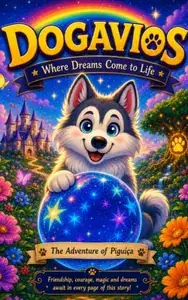
If your child asked for «just one more» and the riddles ran out, there is plenty left to do. The free Pigúiça game runs in the browser, with no sign-up and no ads, and is a nice way to relax after lunch. For busy hands, the coloring pages can be printed for free, and you can even color a fruit that just showed up in a riddle. If your child likes stories, meet Pigúiça, the blue-eyed husky puppy who has adventures in the Magic Garden with her friend Fofuxo in the children's book Dogavios.
Frequently asked questions
At what age do children understand riddles?
Usually around age 3 you can play with very simple clues, such as color and shape, and show the answer at the end. Between 5 and 8, children tend to enjoy them more, because they can combine several clues and reason on their own.
Do riddles help kids who do not like vegetables?
They can. By playing at guessing the vegetable, your child has a positive, pressure-free contact with the food: they see it, touch it and talk about it. That does not guarantee they will like it, but it often reduces resistance over time.
Can I make up my own food riddles?
Of course. The formula is simple: pick a food and describe its color, shape, where it grows or comes from, and how it is used. Always end with «What am I?». Letting your child invent one is a great way to practice vocabulary and imagination.
Your next adventure could be a moment together.
Now that you have met Pigúiça here, discover the story behind her world. See the illustrations, read the beginning and choose a book to share with your child, one page at a time.
Your next adventure could be a moment together.
Now that you have met Pigúiça here, discover the story behind her world. See the illustrations, read the beginning and choose a book to share with your child, one page at a time.