The world you follow can be part of story time too.
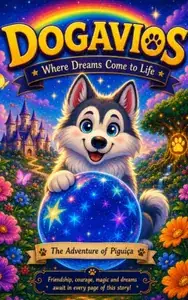
In the Dogavios books, Pigúiça’s adventure moves at the pace of your family’s reading. Open the sample, explore the illustrations and discover the story one page at a time.
If you've noticed your child always picks the show with the dog, it isn't coincidence or a lack of imagination. There's a concrete reason dogs work so well in children's stories, and understanding it helps you choose better content and start conversations worth having.
Why dogs work so well
- Emotion with no disguise: a dog doesn't hide what it feels. Wagging tail is joy, flattened ears are fear. For a child still learning to read emotions, that's an open book, far easier than decoding complex human faces.
- A safe place to project: talking about the dog's fear is easier than talking about your own. The canine character becomes somewhere safe to put what a child can't yet name.
- Loyalty you can see: friendship is an abstract concept. A dog waiting at the door is friendship made visible.
- Small scale: a dog's adventures fit inside a child's world, a garden, a park, a house. They can picture themselves in it.
What makes a good dog cartoon
- A dog with personality, not a mascot: the best canine characters have fears, stubbornness and flaws. A dog that's only cute teaches nothing.
- No violence between animals: chases and fights between animals land harder than adults expect, because the child identifies with the animal.
- Real behavior mixed with fantasy: when a show has the dog sniffing, digging, or startling at noise, it teaches about real animals alongside the story.
How to use the interest
- Use the dog to name feelings: "look, her ears went down, do you think she got scared?" It's the most painless way to teach emotional literacy there is.
- Connect to a real dog: if you have one at home or see one on your street, build the bridge. "Does Rex do that too when he's happy?"
- Turn it into play: after the episode, ask your child to act out the happy dog, the scared dog, the brave dog. Emotion that goes through the body sticks better than emotion that's only discussed.
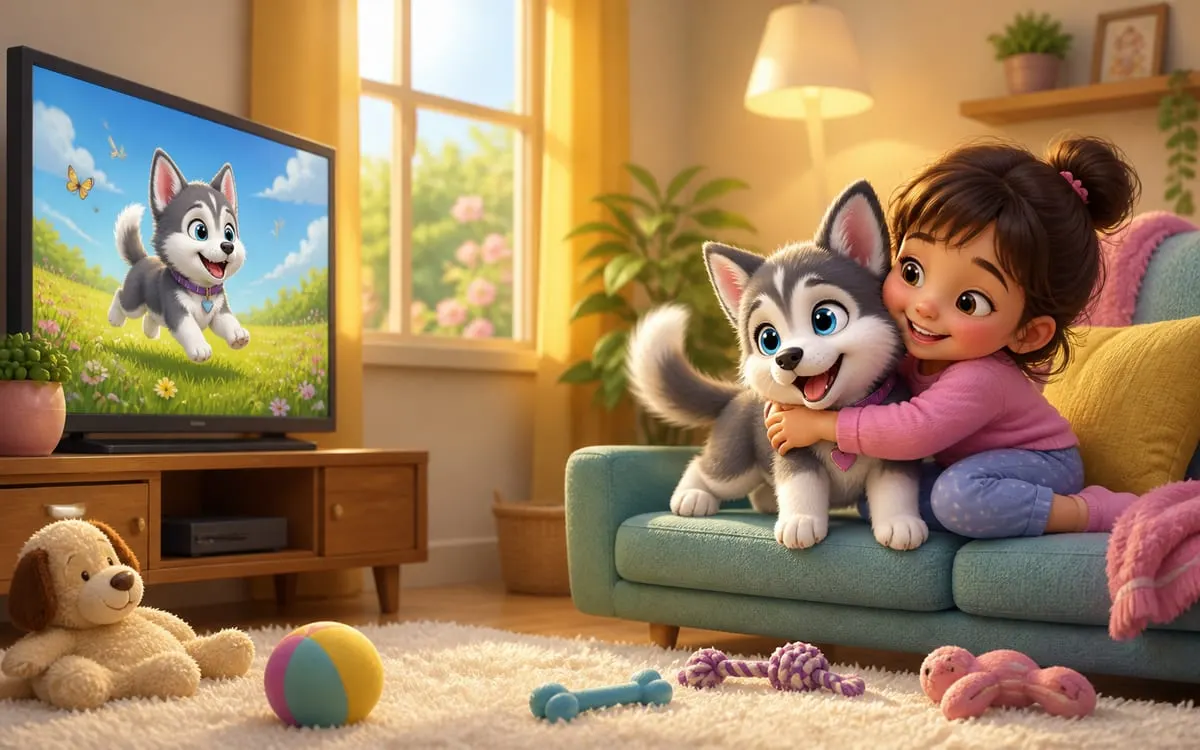
Those reasons are exactly why Dogavios was built around a dog. Pigúiça is a blue-eyed husky who faces fear, jealousy and missing someone in the Magical Garden, with each episode working through one emotion at a time. There are seven short, free episodes with no violence, made from the picture book. And if your child wants to walk through the Garden alongside her, the browser game is free too.
The world you follow can be part of story time too.
In the Dogavios books, Pigúiça’s adventure moves at the pace of your family’s reading. Open the sample, explore the illustrations and discover the story one page at a time.