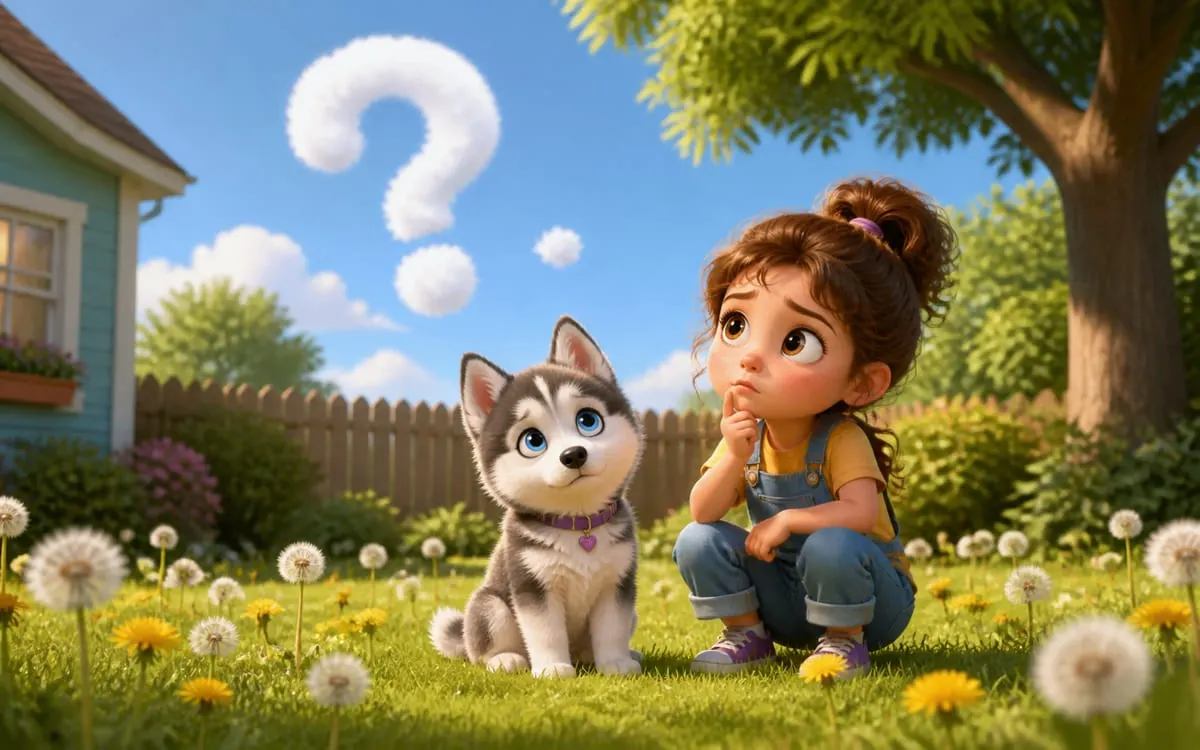
Your next adventure could be a moment together.
Now that you have met Pigúiça here, discover the story behind her world. See the illustrations, read the beginning and choose a book to share with your child, one page at a time.
Looking for bug and insect riddles for kids? Here are 20 riddles with answers, sorted by age, for the garden, the car or bedtime. Read the clue, wait for the guess, and only then reveal the answer.
How to play without any fuss
Read each riddle slowly, in your best mystery voice. If your child gets stuck, repeat the clue and add a hint, like the sound the critter makes or where it lives. Wrong guesses are part of the fun: what matters is laughing together.
The riddles go from easier to harder. Start with your child's age group and move on if they get everything right.
Riddles for ages 3 and 4
At this age, clues should be short and about critters kids have already seen in the yard, the park or picture books. Add gestures and sounds to help.
- I fly from flower to flower going bzzz, and I make the honey you spread on toast. What am I? A bee.
- I am tiny and I walk in a line carrying leaves much bigger than me. What am I? An ant.
- I was a caterpillar, I slept in a cocoon and I woke up with colorful wings. What am I? A butterfly.
- I am red with black spots, and they say I bring luck when I land on you. What am I? A ladybug.
- I have no legs, I crawl in wet soil and I spend my days digging tunnels. What am I? An earthworm.
- I move very slowly with my house on my back and leave a shiny trail behind me. What am I? A snail.
Riddles for ages 5 and 6
Now you can use clues with two parts: one about the looks and one about what the critter does. Ask your child to explain how they got the answer.
- I have eight legs and weaving is my job. I make a web to catch my dinner. What am I? A spider.
- When night falls, I switch on a little light in my belly and blink in the dark. What am I? A firefly.
- I sing at night by rubbing my wings together: chirp-chirp, chirp-chirp. What am I? A cricket.
- I am green, I eat lots of leaves and one day I will turn into a butterfly. What am I? A caterpillar.
- I have four see-through wings and I zoom near the pond like a tiny helicopter. What am I? A dragonfly.
- I buzz right by your ear at night and leave an itchy little bump. What am I? A mosquito.
- I land on fruit, rub my little legs together and zoom off when you try to catch me. What am I? A fly.
Riddles for ages 7 and 8
Kids this age love a challenge. Keep the answer hidden and let everyone guess three times before you reveal it.
- In summer I cling to tree trunks and sing so loud the whole woods can hear me. What am I? A cicada.
- I stand still with my front legs folded as if praying, waiting for the moment to grab my prey. What am I? A praying mantis.
- I have a hard, shiny shell, and some of my cousins roll balls of dung. What am I? A beetle.
- My name says I have a hundred feet, but that is an exaggeration. I do have lots of little legs. What am I? A centipede.
- I make huge jumps with my back legs, and my green color hides me in the grass. What am I? A grasshopper.
- When I get scared, I curl up into a tight little ball. What am I? A pill bug.
- I look like a dry twig and I stay still among the leaves so nobody sees me. What am I? A stick insect.
Why riddles are good for kids
Riddles look like pure fun, but they teach a lot. A child has to listen closely, keep the clues in memory and connect one idea to another. That exercises reasoning without feeling like a lesson.
They also spark curiosity about nature. After guessing the ladybug or the firefly, kids often want to know where it lives, what it eats and how it grows. Use the question as a chance to look at a leaf, a flower or a flowerbed together.
And it is a moment just for the two of you. No screens, no rush, only the voice of the storyteller and the sparkle in the eyes of the one who figures it out. Ten minutes like that at the end of the day bring laughter and good chats.
Tips to make the game last
Let your child make up their own riddle. Asking them to describe a favorite critter without saying its name builds vocabulary, attention and imagination at once.
Take the riddles on a walk. Look for ants on the sidewalk, snails after the rain and butterflies on the flowers. Just watch from a distance or gently, without squeezing or hurting the critters, and wash hands after playing in the dirt. An adult should stay close, especially around bees and spiders, which can sting or bite.
After the riddles, why not play? Pigúiça has a free game in the browser, with no sign-up and no ads. If your child prefers pencils, our printable coloring pages are free too.
These games fit the spirit of the book Dogavios, where the husky Pigúiça and her friend Fofuxo discover new things in the Magic Garden.
Frequently asked questions
At what age do kids start to understand riddles?
Around age 3, as long as the clue is short and about something familiar. Little by little they can handle more abstract clues.
What if my child gets none right?
That is fine. Give hints, show a picture of the critter or make its sound. The fun is in thinking together, not in getting it right the first time.
Can I use these riddles at school or at parties?
Absolutely. They work well in circle time, birthdays and outdoor trips, because they need no materials at all.
Your next adventure could be a moment together.
Now that you have met Pigúiça here, discover the story behind her world. See the illustrations, read the beginning and choose a book to share with your child, one page at a time.
Your next adventure could be a moment together.
Now that you have met Pigúiça here, discover the story behind her world. See the illustrations, read the beginning and choose a book to share with your child, one page at a time.