Your next adventure could be a moment together.
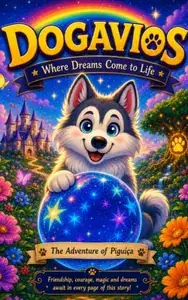
Now that you have met Pigúiça here, discover the story behind her world. See the illustrations, read the beginning and choose a book to share with your child, one page at a time.
Antarctic animals for kids include penguins, seals, whales and even a tiny creature called krill. In this guide you will meet 12 of them, each with short fun facts that are easy to read aloud to children aged 3 to 8.
Antarctica is the coldest, driest and windiest continent on Earth. Even so, the sea around it is full of life. If someone in your family lives or works at a research station down there, this post is also a lovely way to bring the kids closer to that white and blue world.
12 Antarctic animals to meet
- 1. Emperor penguin: It is the biggest penguin of all. The egg rests on the parents’ feet, under a warm fold of skin. In winter, the dad keeps the egg on his feet while the mum goes to sea to find food. Once the chick hatches, they take turns.
- 2. Adélie penguin: It is much smaller than the emperor, with a white chest and a black back. To build a nest, it collects little piles of pebbles. Sometimes a penguin tries to take a neighbor’s pebbles, how naughty!
- 3. Gentoo penguin: It has a white patch near each eye and an orange beak. It is a great swimmer and spends much of the day at sea, looking for food.
- 4. Chinstrap penguin: It has a thin black line under its head that looks like the strap of a helmet. That is how it got its name. It lives in big groups called colonies.
- 5. Weddell seal: It spends lots of time under the ice and keeps holes open so it can come up to breathe. It is a great diver. Can you hold your breath like a seal? Just for a few seconds!
- 6. Leopard seal: It has spots like a leopard and a big head. It is a quick hunter that eats fish, krill and even penguins. We admire it from far away.
- 7. Crabeater seal: The name is tricky: it does not eat crabs! Its favorite meal is krill, and its teeth work like a sieve that keeps the food and lets the water out.
- 8. Blue whale: It is the biggest animal on the planet, bigger than any dinosaur. In summer it visits the icy waters of Antarctica to eat krill, lots and lots of krill.
- 9. Humpback whale: It also shows up in summer to feed. It is famous for leaping out of the water and for singing songs that travel far under the sea.
- 10. Orca: It is the biggest dolphin in the world, even though many people call it a whale. It lives in close families and talks with whistles and other sounds.
- 11. Krill: It is a tiny crustacean, a bit like a shrimp. It looks like very little, but it is the base of the food chain: penguins, seals and whales depend on it, from near or from afar.
- 12. Skua: It is a clever, bold seabird. It flies everywhere and likes to stay near penguin colonies, watching for any chance to find food.
How to explain Antarctica to kids
Start with the basics: Antarctica is a giant continent covered in ice, at the very bottom of the planet. It is freezing and very windy. That is why nobody lives there forever. Only researchers stay at stations for a while, studying the ice, the weather and the animals. Use simple words and let your child ask anything.
Tell them, too, that countries agreed on the Antarctic Treaty, which keeps the continent for peace and science. It opens a great chat about taking care of nature. And remember: people who visit Antarctica keep their distance from the animals, because they are not toys or pets.
For little ones, try a comparison: imagine the freezer in your fridge, as big as a continent. Pigúiça, who is a husky and loves the cold, would be delighted by all that snow. If your child does not know her yet, tell them who Pigúiça is, the star of the book Dogavios.
Games at home to feel Antarctica
Play penguin: balance a light ball or a rolled-up sock on your feet and walk slowly without dropping it, just like the emperor penguin with its egg. Pick an open space with no obstacles and take turns, grown-ups and kids. Afterwards, ask which animal your child would like to be, and why.
Melting ice: put ice cubes in a basin with big toy animals, with no small parts. Watch the ice melt and talk about what happens to animals when the ice changes. Always do it with an adult nearby.
Color the animals: grab some free coloring pages and color the animals from the list in blues and whites. Then take a break with the free Pigúiça game. It runs in the browser, with no sign-up and no ads.
Frequently asked questions
Are there polar bears in Antarctica?
No. Polar bears live in the Arctic, in the north. Penguins live in the south, so they would only meet in a made-up story.
Does anyone live in Antarctica?
There are no permanent residents. Researchers and support teams work at stations for set periods, and then go back home.
How do I read this guide with a small child?
Read one animal at a time, show a photo or a drawing and ask: what do you think it eats? If your child loses interest, stop and pick it up another day. Repeating the same animal many times is fine too, kids love that.
Your next adventure could be a moment together.
Now that you have met Pigúiça here, discover the story behind her world. See the illustrations, read the beginning and choose a book to share with your child, one page at a time.