Your next adventure could be a moment together.
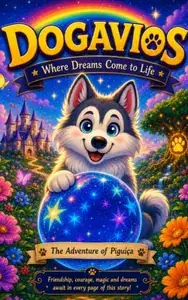
Now that you have met Pigúiça here, discover the story behind her world. See the illustrations, read the beginning and choose a book to share with your child, one page at a time.
Cat jokes for kids that really get giggles: here are 25 short, clean and easy-to-tell jokes, ready for dinner time, the car or bedtime. They are chosen for kids aged 3 to 8, with nothing scary and no hard words.
Cats are champions at making people laugh. They pounce, hide in boxes, purr and pretend nothing happened. That is why cat jokes work so well with little ones, who love animals and love them even more when the animal acts silly.
Short jokes for ages 3 to 5
At this age the fun is in the sound, the repetition and the face you make while telling it. Do not worry if your child does not get every word: they laugh because you are laughing.
- What sound does a happy cat make? Purr, the little love motor!
- Why do cats love boxes so much? Because inside, they become king of a tiny castle!
- What did the cat say when it saw the milk? Meow-velous!
- Why did the kitten take the blanket? It planned a five minute nap and ended up sleeping all afternoon!
- What is the kitten's favorite game? Chasing a ball of yarn and pretending it ran away!
- What did the cat say to the ball of yarn? Come here, I want to play with you!
- Why does the cat close its eyes when drinking milk? Because it thinks that if it cannot see, nobody can see its white whiskers!
- How does a cat greet its friends? With a meow-llo!
Wordplay jokes for ages 6 to 8
Now come the word games. Kids who are reading or learning to read love finding the hidden trick, and many want to repeat the joke to someone else right away.
- Why do cats love computers? Because there is a mouse inside to chase!
- How does a cat say goodbye? See you later, purr-ocodile!
- What did the cat say when it woke up feeling a bit sick? I am feeling a little meow-dy.
- What is the cat's favorite kind of music? Meow-sic, of course!
- Why did the cat go to school? To learn the alphabet: a, b, c, meow!
- Why is the cat good at soccer? Because it jumps high and never takes its eyes off the ball!
- What is the cat's favorite movie? The Lion King, because the lion is its giant cousin!
- Why does a cat always land on its feet? Because it practiced a lot on the living room rug!
- Why is the cat the hide and seek champion? It hides so well that sometimes even the cat forgets where it is!
Cat riddles for the whole family
Riddles are great for the car and the table because everybody joins in. Pause dramatically before the answer and let your child guess first.
- What has whiskers, is not a king, purrs and loves to sleep? A cat!
- What has four paws, walks without a sound and loves a cardboard box? A cat!
- What has eyes that glow in the dark and velvet steps? A cat!
- What is soft, lives on the couch and purrs when petted? A kitten!
- What has a rough tongue, washes itself and never needs a bathtub? A cat!
- What has whiskers but never needed to shave? A cat!
- What has a long tail, walks softly and watches the window? A cat!
- What jumps off the couch, is light as a feather and lands on its feet? A cat!
How to tell a joke to a child the right way
Go slowly and use the animal voice
Use a tiny kitten voice, open your eyes wide and stretch out the meow. Small kids laugh more at the acting than at the joke itself.
Let your child guess first
Before giving the answer, ask: what do you think? Even a wrong guess is often funnier than the real punchline.
Repeat the favorite
If your child asks for the same joke ten times, that is normal. Repeating is part of learning language, humor and rhythm.
Invite your child to invent
Ask: what if the cat were an astronaut? Or a chef? Making up jokes builds vocabulary and imagination, and it usually gets the whole family laughing.
Keep the fun going
After the jokes, why not play? In Pigúiça's free game, the little blue-eyed husky puppy goes on adventures in your browser, with no sign-up and no ads. If your child loves animals, you can also print some free coloring pages and let them color the cat any way they imagine.
Want to meet the character? Read who Pigúiça is and find out how she and her friend Fofuxo live in the Magic Garden, the setting of the book Dogavios: Where Dreams Come to Life.
Frequently asked questions
What is the best age for cat jokes?
From age 3, with short jokes full of sounds like purr and meow. From 6 to 8, wordplay and riddles get funnier because kids understand double meanings.
Do these jokes work at bedtime?
Yes. Pick the calmer ones, tell them softly and end with a quiet giggle. Avoid very wild jokes close to sleep so your child does not get wound up.
Why does my child not laugh at some jokes?
That is normal. Wordplay depends on the child already knowing the word. If there is no laugh, switch to a sound joke or an animal joke and try again later.
Your next adventure could be a moment together.
Now that you have met Pigúiça here, discover the story behind her world. See the illustrations, read the beginning and choose a book to share with your child, one page at a time.
Your next adventure could be a moment together.
Now that you have met Pigúiça here, discover the story behind her world. See the illustrations, read the beginning and choose a book to share with your child, one page at a time.