Your next adventure could be a moment together.
Now that you have met Pigúiça here, discover the story behind her world. See the illustrations, read the beginning and choose a book to share with your child, one page at a time.
Dinosaurs are one of kids' favorite subjects, and the questions never end. Here are 15 curious dinosaur questions for kids, each with a short, fun answer, ready to read aloud at breakfast, in the car or at bedtime.
We only use well-established facts and skip the complicated numbers. If your child wants to know more, wonderful: that is the perfect excuse to look things up together.
Giant, long-necked dinosaurs
First up, the big ones that made the ground shake.
- Why did the brachiosaurus have such a long neck? To reach leaves high up in the trees, where other animals could not. It was like having a salad bar way up high, just for itself.
- Did the giant dinosaurs eat meat? The biggest ones of all, the long-necked kind, ate plants. They spent the day munching leaves to fuel those huge bodies.
- What were the triceratops's horns for? For defending itself and also for showing off to other triceratops. The big bony frill behind its head helped protect it.
- What were the plates on a stegosaurus's back for? Scientists think they were for showing off and maybe for helping control body heat. There is still a lot of debate, and that is just how science works.
Meat-eating dinosaurs with sharp teeth
Now the hunters, gently, so we do not scare the little ones.
- Did the Tyrannosaurus rex have big teeth? It sure did! They were strong and pointy, perfect for biting. You can see fossils of them in museums.
- What were the T. rex's tiny arms for? They were very short compared with its body, but strong. Scientists are still studying exactly what they were for, and it is one of the most famous puzzles in the field.
- Was the velociraptor giant like in the movies? No! It was much smaller than in the movies, and it had feathers. Movies make up a lot of things.
- Did meat-eating dinosaurs walk on two legs? Most of them did, standing on their back legs with the tail helping them balance.
Feathers, eggs and flying
This is where the story gets surprising.
- Did any dinosaurs have feathers? Yes! Fossils of feathered dinosaurs have been found. Feathers could help keep the body warm and be used for showing off.
- Are birds related to dinosaurs? Yes, very closely. Scientists explain that today's birds descend from a group of dinosaurs. Next time you see a sparrow, remember that.
- Was the pterosaur a dinosaur? No, it was a cousin. Pterosaurs were flying reptiles that lived at the same time, but they belong to a different group.
- Did dinosaurs hatch from eggs? Yes. They laid eggs, and fossilized nests and eggs have been found. Some dinosaurs even took care of their nests.
What happened to the dinosaurs
Last, the most famous mystery of all.
- Why did the dinosaurs disappear? Scientists explain that a huge asteroid hit the Earth a very, very long time ago, and the climate changed. Many animals could not handle the change.
- Did dinosaurs live at the same time as people? No. They lived millions of years before there were any humans. No person ever saw a real dinosaur.
- How do we know so much about animals from so long ago? From fossils: bones, teeth, footprints and eggs that turned to stone. Scientists called paleontologists study all of it, like detectives of the past.
The home museum game
A great way to use this list is to build a dinosaur museum at home. It is simple and takes just a few minutes.
Pick one question and read only the question. Everyone makes a guess, even the wildest one, and every guess earns applause. Then read the answer and see who came closest.
To stretch the fun, ask your child to draw the dinosaur of the day. Our free printable coloring pages help a lot here. And if you want to keep the imagination going, Pigúiça's free game runs in the browser, with no sign-up and no ads.
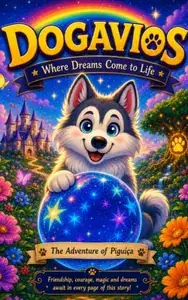
If your little ones also love stories with animals, meet the book Dogavios, with Pigúiça the husky and her friend Fofuxo in the Magic Garden.
Tips for researching together
Let your child ask first and answer in just a few words. Short answers hold attention better than long explanations. Look things up together in children's books and trusted websites, and remember that science keeps finding new things: that is why sometimes the answer changes.
Visiting a science museum or watching a kids' documentary works great too. Do the voice of a giant dinosaur, the heavy steps of the brachiosaurus or the roar of the tyrannosaurus: kids learn while laughing. And if a movie scares them, remind them that dinosaurs lived a very long time ago and are gone now.
Frequently asked questions
What age are these questions for?
They work well from ages 3 to 8. Younger kids enjoy the animals and their sounds, and older ones like understanding the reason behind everything.
What if I do not know the answer to my child's question?
No problem! Say you do not know and look it up together in a book or a trusted website. Showing that grown-ups learn too is a valuable lesson.
Why do some dinosaur facts change over time?
Because scientists keep finding new fossils and studying the old ones. When a new discovery comes along, what we know gets updated, and that is part of the fun of researching.
Your next adventure could be a moment together.
Now that you have met Pigúiça here, discover the story behind her world. See the illustrations, read the beginning and choose a book to share with your child, one page at a time.