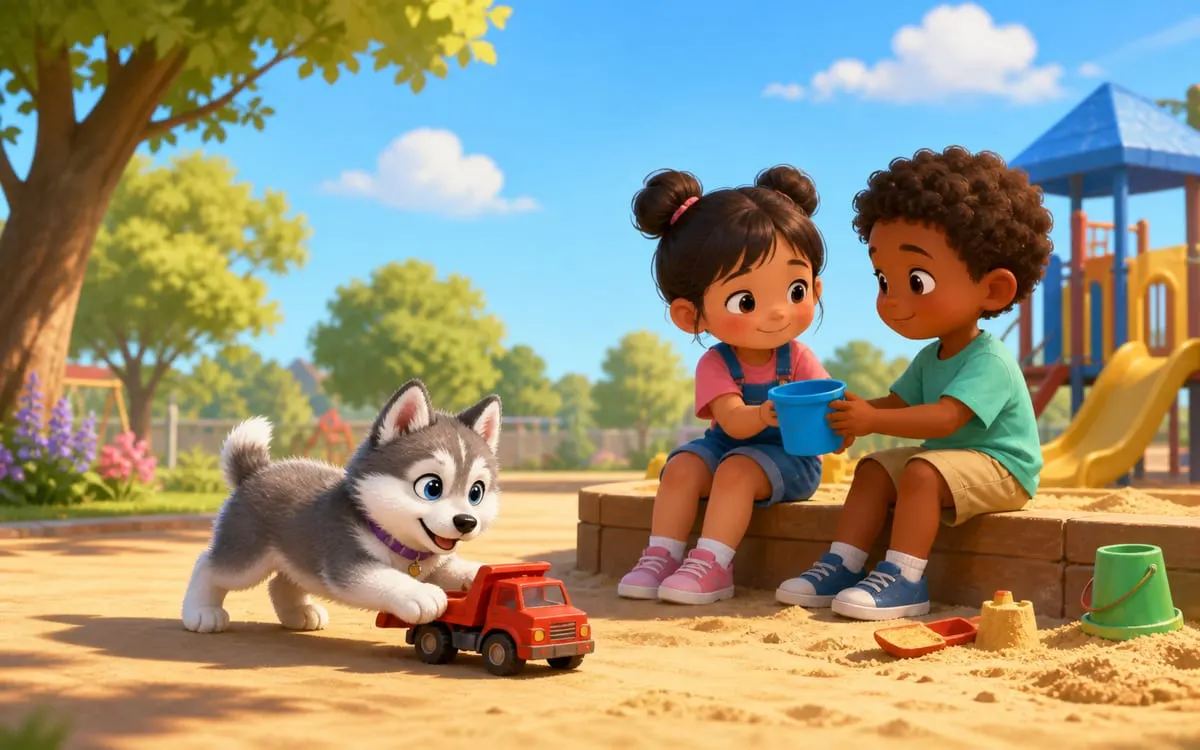
Your next adventure could be a moment together.
Now that you have met Pigúiça here, discover the story behind her world. See the illustrations, read the beginning and choose a book to share with your child, one page at a time.
Few moments make parents cringe like a child clutching a toy and shouting “mine!” while another child sobs. Before you blame yourself, know this: until around age four or five, children are still building the concept of ownership, and they need to feel something is truly theirs before they can lend it. Forcing a handover on a countdown usually teaches two wrong lessons: that whoever cries wins, and that their own wants don't count.
Swap “share” for “take turns”
- Let the turn finish: “Peter has the truck. When he's done, it's your turn.” Waiting for a natural end is fairer, and easier to grasp, than splitting on demand.
- Teach asking and declining: “Can I play when you're finished?” and also “I'm still using it, I'll call you.” A respectful no is part of the skill.
- Use a visual timer: a sand timer turns an abstract argument into something a child can see.
- Put treasures away before playdates: let your child pick two or three toys they won't have to lend. This alone prevents most conflicts.
What to say during the conflict
- Describe without judging: “Two kids want the same car. That's hard.”
- Validate both sides: “You really want the car. And she really wants it too.”
- Invite a solution: “What could we do to fix this?” From about four, kids come up with surprisingly good ideas.
- Skip the labels: “so selfish” becomes a prophecy. Try “sharing is genuinely hard, and you're learning.”
- Don't force lending the favorite: you wouldn't hand your phone to a stranger just because they asked either.
How to grow real generosity
- Notice it when it happens on its own: “You gave her a piece of your cookie. Look at that smile.” Naming the effect teaches the pleasure of giving.
- Choose cooperation over division: a tower built by four hands, shared clay, a two-person puzzle.
- Lend your own things out loud: “I'm lending my umbrella to our neighbor. She'll need it today.”
- Be patient with brain time: genuine generosity shows up well after the age most of us start demanding it.
- Prep your child before you go: on the way to a friend's house, agree that “those are someone else's toys, and we ask before taking.” Naming the rule in advance prevents about half the conflicts that would happen at the door.
- Don't solve everything for them: wait a few seconds before stepping in. Many disputes resolve themselves, and every one of those is a free negotiation lesson.
Real sharing grows out of empathy, and empathy is learned by feeling what someone else feels. Stories do that work gently: in Dogavios, the husky Pigúiça faces moments in the Magical Garden where she must choose between keeping something to herself or including a friend, and children follow that decision from the inside, with nobody telling them what they should do.
Your next adventure could be a moment together.
Now that you have met Pigúiça here, discover the story behind her world. See the illustrations, read the beginning and choose a book to share with your child, one page at a time.