Your next adventure could be a moment together.
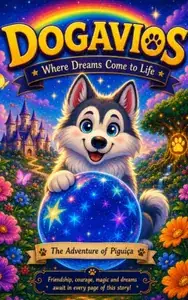
Now that you have met Pigúiça here, discover the story behind her world. See the illustrations, read the beginning and choose a book to share with your child, one page at a time.
People who grew up with a dog often say they learned things there they learned nowhere else. That is not just nostalgia: living with animals has measurable effects on child development. But it is worth separating what is real from what has become an internet slogan, because an animal at home is also work, and the benefits only show up when the care is genuinely there.
Benefits that hold up
- Applied empathy: the dog cannot talk. A child has to read posture, ears and tail to understand how he feels. That is daily practice in non-verbal signals.
- Concrete responsibility: filling the water bowl has a visible consequence. Tasks with real effects teach more than any lecture about commitment.
- Movement and fresh air: families with dogs walk more. The walk becomes routine, and the child comes along.
- Emotional regulation: stroking an animal is calming. Many children seek out the dog after a frustration, and that is a legitimate self-soothing resource.
- Reading confidence: reading aloud to a dog is used in schools precisely because the dog never corrects and never judges.
- Company without judgement: through house moves, sibling fights and bad days, the dog is a stable presence.
What is overstated
- “Dogs prevent allergies”: some studies suggest lower risk in children exposed early, but it is neither a guarantee nor a reason to get a dog. Ask your paediatrician.
- “A pet teaches responsibility by itself”: it teaches if an adult supervises, reminds and models it. Otherwise it becomes another forgotten chore.
- “Every child gets on with dogs”: some are frightened, and forcing contact makes it worse. Respect the pace.
- “A pet replaces friends”: it complements, never replaces, time with other children.
Making sure the benefits actually happen
- Age-appropriate jobs: three to five year olds fill the water bowl with help; six to nine brush and help on walks; ten and up measure food and join in training.
- The adult stays responsible: the child participates, the adult guarantees. Animal welfare must never depend on a child's memory.
- Involve them in care, not just play: vet visits, tooth brushing, watching for changes. Caring is more formative than playing.
- Talk about boundaries: understanding that the dog has rest time teaches respect for someone else's space, a lesson that lasts a lifetime.
- Prepare for the goodbye: a dog's life is short. Talking about it honestly, at the child's pace, turns loss into a first lesson in grief that is held gently.
- Do not force the bond: if the child prefers to play at a distance, that is fine. Affection arrives on its own when nobody pushes.
Perhaps the greatest gift of growing up with an animal is this: discovering early that another living being has wishes of its own, and that loving means respecting them. If you want to open that conversation in a warm way, Pigúiça, the blue-eyed husky from Dogavios, shows children exactly that, with adventure, humour and tenderness.
Your next adventure could be a moment together.
Now that you have met Pigúiça here, discover the story behind her world. See the illustrations, read the beginning and choose a book to share with your child, one page at a time.