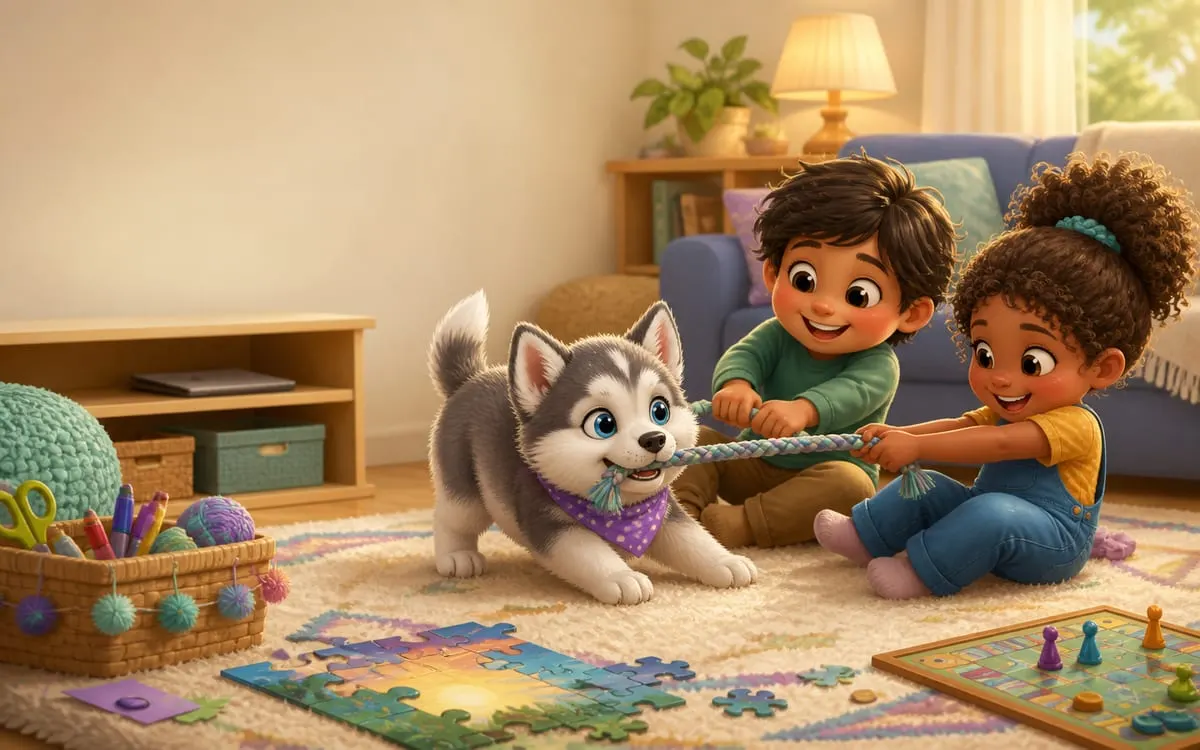
Your next adventure could be a moment together.
Now that you have met Pigúiça here, discover the story behind her world. See the illustrations, read the beginning and choose a book to share with your child, one page at a time.
Deciding to cut down on screens is never the hard part. The hard part is the moment right after, when your child looks up and says "so what do I do now?". Without a ready alternative, the screen wins every time. So it helps to keep a short list in your head, and a plan for the first twenty minutes, which are always the loudest.
For the difficult ten minutes (the transition)
- The five-minute warning: switching off suddenly guarantees a blow-up. Warn first, in the same calm tone every time, then follow through.
- An immediate physical task: fetch something from another room, fill a water jug. Moving the body interrupts the crying loop.
- A closing ritual: let them switch the device off and put it away in the agreed spot. Handing over control cuts resistance sharply.
Twenty to thirty minute ideas
- Homemade play dough: flour, salt, water and oil. Making the dough is half the activity.
- Blanket den: a sheet, two chairs and a torch. It becomes a reading nook, a hideout, a house.
- Treasure hunt with drawn clues: five clues around the house. Three minutes to set up.
- Junk-modelling workshop: a box of tubes, lids and pots. No instructions, no example to copy.
- A letter or drawing for someone: actually delivering it afterwards is what gives it meaning.
- Cooking together: any five-ingredient recipe. Occupies hands and head at once.
Ideas they can do alone
- The special box: a box that only comes out at certain moments, with stickers, blocks or a puzzle. Rarity keeps the magic.
- Audiobook plus free drawing: listening to a story while drawing fills long stretches with no screen at all.
- Drawing diary: a notebook that's only theirs, one drawing a day.
- Blocks with a challenge: "build a bridge that holds this car". A clear goal outlasts loose blocks by miles.
- Looking after a plant: daily responsibility and a slow reward, the exact opposite of what a screen offers.
Setting the house up for it
- Keep materials within reach: paper, pencils and blocks on a low shelf. If they have to ask, they give up and ask for the screen instead.
- Make the play space visible: a rug and an open box in the living room beats a tidy bedroom behind a closed door.
- Put the screen out of sight: a tablet on the table is a permanent invitation. Out of the visual field, the asking drops on its own.
What changes in a week
Brace yourself: the first three days are usually the worst. A child used to fast stimulation finds everything slow at first, complains, and announces they're bored. Hold the line. Around day four or five, independent play comes back on its own, and they start inventing things you'd never have thought of.
One extra tip: leave books in the places where your child actually sits, not only on the bedroom shelf. Easy access does more than any speech about the importance of reading.
Your next adventure could be a moment together.
Now that you have met Pigúiça here, discover the story behind her world. See the illustrations, read the beginning and choose a book to share with your child, one page at a time.