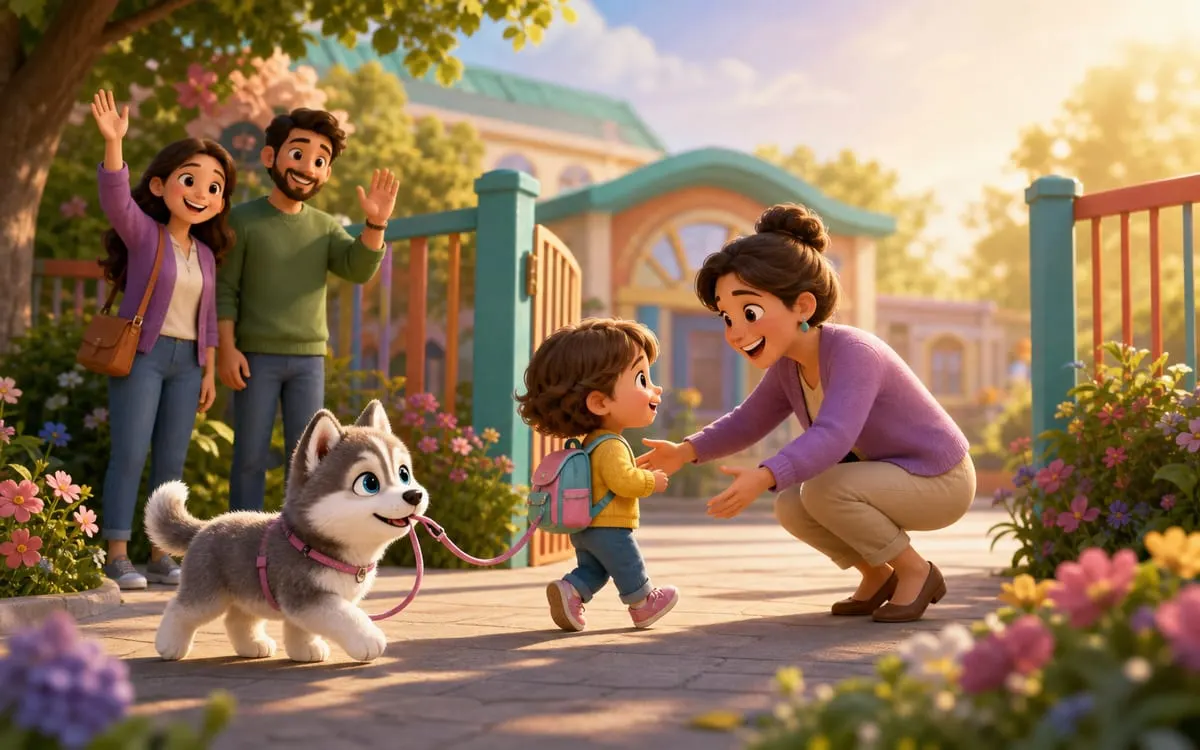
Your next adventure could be a moment together.
Now that you have met Pigúiça here, discover the story behind her world. See the illustrations, read the beginning and choose a book to share with your child, one page at a time.
Few things ache like handing over a crying child at the classroom door and walking away. School adjustment is real work for a small nervous system: your child is learning that you leave, that the world keeps going, and that you always come back. That takes time, and the amount of time varies wildly. Some children settle in three days, others need six weeks. Neither one is broken.
Before you leave the house
- Narrate the day in advance: walk through the routine out loud the night before and again at breakfast. "You'll play, eat your fruit, sing, and then I come back." Predictability calms far better than promised rewards.
- Send a piece of home: a scarf that smells like you, a laminated photo in the backpack, a friendship bracelet you braided together. It's a physical anchor for the mid-morning wobble.
- Manage your own nerves: children read our tension through tone and rush. Leave ten minutes early so arrival isn't frantic.
The goodbye itself
- Short and identical every time: one hug, one ritual phrase ("back after snack"), then go. Stretching the exit makes crying worse, not better.
- Never sneak out: it dodges the scene but teaches that you can vanish at any moment, so your child starts monitoring you all day.
- Agree on a signal with the teacher: ask for a text fifteen minutes later. Most of the time the crying stops within five.
After pickup
- Skip the interrogation: "how was it?" earns "fine." Try concrete questions instead: "who sat next to you?", "what song did you sing?"
- Expect regressions: bedwetting again, wanting a bottle, needing to sleep in your bed. That's emotional energy spent, not backsliding. It passes.
- Give fifteen undivided minutes: phone away, on the floor, playing whatever they choose. It refills the security tank for tomorrow.
If after two months the distress is still intense, refusing to eat at school, persistent sadness at home, talk to the school coordinator and your pediatrician. Not to panic, but to understand what this particular child is asking for. And in the evenings of this phase, stories carry a lot: Pigúiça, in Dogavios, also needs courage to walk into the Magical Garden alone, and reading about someone who feels afraid and goes anyway is one of the kindest ways to tell your child: I get it.
Your next adventure could be a moment together.
Now that you have met Pigúiça here, discover the story behind her world. See the illustrations, read the beginning and choose a book to share with your child, one page at a time.