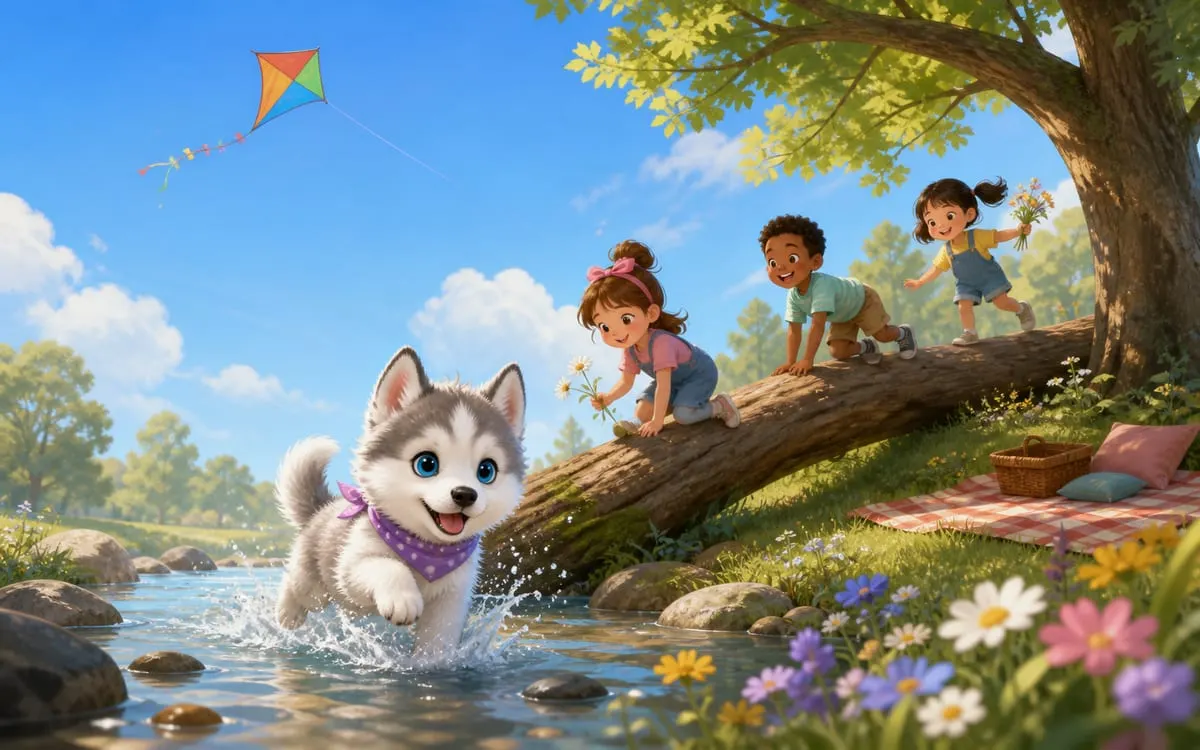
Your next adventure could be a moment together.
Now that you have met Pigúiça here, discover the story behind her world. See the illustrations, read the beginning and choose a book to share with your child, one page at a time.
Every parent knows it: when a child spends an afternoon outside, the whole day improves. Sleep comes easier, appetite returns, moods lift. What stops us usually isn't willpower, it's the feeling that outdoors requires a plan, a drive and some money. It doesn't. The best outdoor activities happen within two hundred metres of your front door.
In the yard, on the balcony, on the pavement
- Chalk on the ground: hopscotch, a maze, an outline of their whole body. One stick of chalk lasts weeks.
- Wash anything: the bike, plastic toys, the patio. A bucket, a sponge and water fill an hour easily.
- Minibeast hunt: look for ants, ladybirds, worms. A magnifying glass helps, but eyes are enough.
- Water painting: a brush and a bucket to "paint" the wall. It dries itself, zero mess.
- Improvised course: jump, weave, balance. They build it, you hold the stopwatch.
At the park
- Nature bingo: a list of six things, a red leaf, a smooth stone, a feather, something rough. It becomes a mission.
- Collect and sort: leaves or stones brought home and sorted by size, colour or texture.
- Silly races: run like a crab, hop like a frog, waddle like a penguin. Endless giggles and genuinely tiring.
- A real picnic: letting them pack the basket is half the fun.
- Listening with eyes closed: one minute of silence counting how many different sounds you can name. Surprisingly calming.
Walks that don't end in complaints
- A walk with a mission: find five blue doors, count the dogs, photograph something starting with today's letter.
- They choose the route: at every corner, they decide turn or straight on. The walk becomes their adventure.
- Time the block: how long to walk around it? Can we beat it tomorrow?
Getting them out the door
- Give them a job: they carry the water bottle, they decide when to head back, they hold the bag of discoveries. Responsibility becomes motivation.
- Agree the length first: "we're staying until the sun starts to drop" avoids the going-home battle entirely.
- Bring one simple object: a ball, a piece of chalk or a rope turns any empty space into a game without you having to invent anything.
What about rain?
- Boots and puddles: with the right clothes, rain is the activity, not the obstacle. A warm bath afterwards seals it.
- Watching what water changes: looking at the wet garden and noticing what's different is science too.
After all that running, bodies need a way down. A short story at bedtime closes the loop of the day, and helps children link that good tiredness with comfort, which does wonders for bedtime itself.
Your next adventure could be a moment together.
Now that you have met Pigúiça here, discover the story behind her world. See the illustrations, read the beginning and choose a book to share with your child, one page at a time.