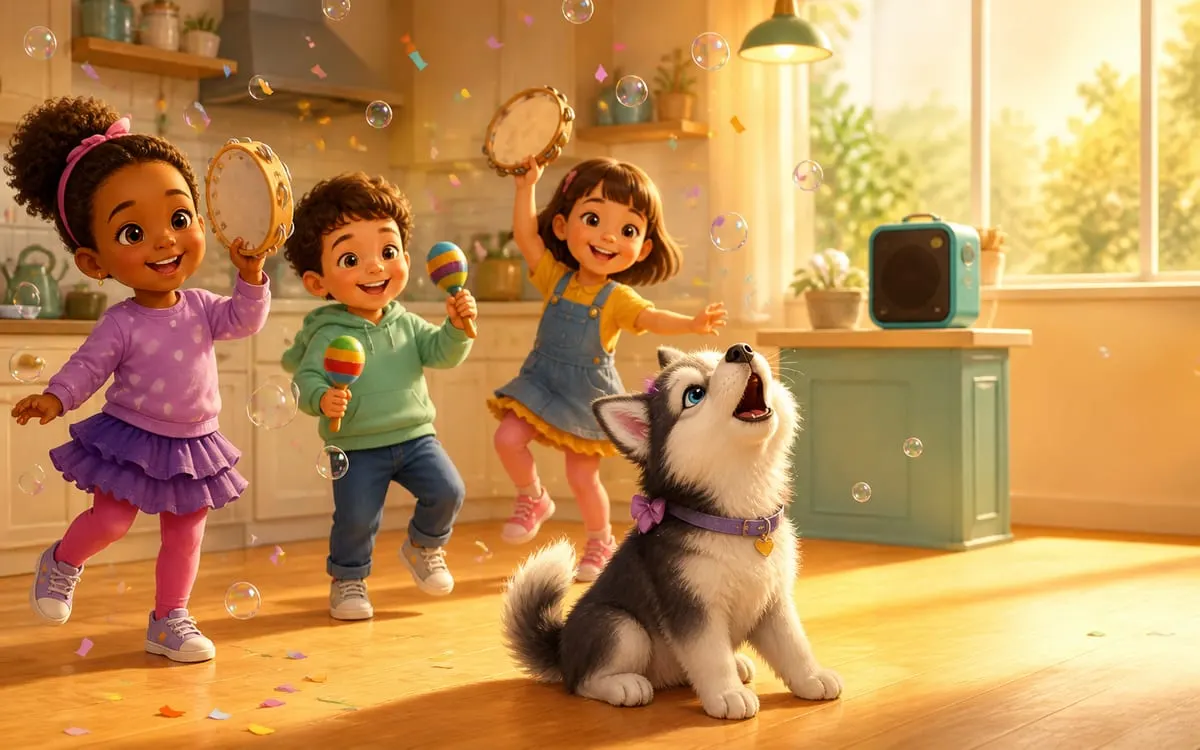

If you want to cut screen time without turning your home into a battlefield, music is probably your best and most underrated ally. It occupies the ears while leaving the body and imagination free, the exact opposite of video. And for young children, rhythmic sound is one of the most powerful learning tools that exists.
Why music teaches so much
- Melody glues vocabulary down: sung words stay in memory in a way spoken words don't. It's why your child remembers an entire lyric but forgets what you asked two minutes ago.
- Rhythm organizes the body: clapping in time trains coordination, attention and anticipation. It looks like a silly game and it's heavy brain work.
- Repetition without boredom: a child hears the same song fifty times and learns more each time. Music withstands that repetition better than any other format.
- Music is the screen that isn't a screen: they can play, draw, run and eat while listening. Video pins the body down. Music sets it free.
Where music fits in the routine
- The hard transition: that moment of leaving the house when nobody cooperates. A fixed "shoes on" song works better than any repeated warning, because it becomes a signal rather than an order.
- Tidy-up time: the rule is simple and kids love it, the mess has to be gone before the song ends. It turns a chore into a game.
- Bath and dinner: low background music lowers the overall volume of the house, adults included.
- Before bed: here the type changes. Nothing upbeat. Slow instrumental or a genuine lullaby, at the lowest volume you can still hear, with the lights off.