Your next adventure could be a moment together.
Now that you have met Pigúiça here, discover the story behind her world. See the illustrations, read the beginning and choose a book to share with your child, one page at a time.
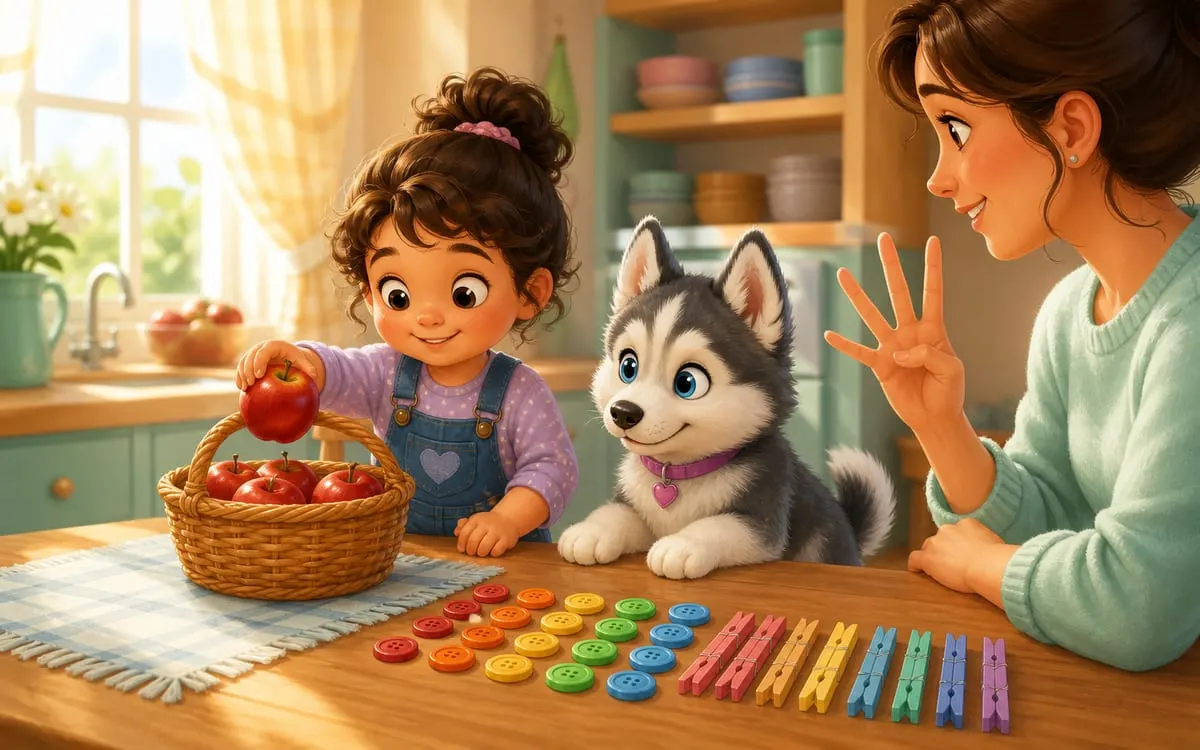
Plenty of children rattle off "one, two, three" up to twenty and then, asked to hand you four bottle caps, deliver a random fistful. That's completely expected: reciting is memory, understanding quantity is a different skill. Teaching numbers for real relies less on tracing worksheets and more on hands moving real objects around the house.
Step one: numbers are amounts
- Count by touching: grab beans, buttons or caps and teach your child to slide each piece aside while saying the number. Pointing in the air leads to counting the same object twice.
- Stop and ask "how many?": after counting five, cover them with your hand and ask again. A child who's got it answers five instantly; one who hasn't starts recounting. It's a quick, revealing check.
- Turn an egg carton into a number line: number the cups 1 to 12 with a marker and have them fill each with the right amount of beans. Free teaching material.
- Practice subitizing: flash three fingers and ask how many without counting. Recognizing small amounts instantly is the foundation of mental math later.
Numbers in daily life, without a lesson
- Stairs: count the steps together going up. The body's rhythm helps lock in the sequence.
- Cooking: "bring me three eggs," "add two spoonfuls." Measuring and portioning is pure math.
- Setting the table: one fork per plate teaches one-to-one correspondence, the backbone of number understanding.
- Shopping: let them hold the coins and pay. Money is the first concrete experience of value.
Beyond counting: comparing and combining
- More and less: make two very different bean piles and ask which has more. Then make them nearly equal to force actual counting.
- Adding under a cup: show three caps, hide them under a cup, add two in plain sight and ask how many are underneath. That's real mental addition, with suspense built in.
- Write the numeral last: the symbol makes sense once the quantity is solid. Tracing a "5" with a finger in flour or sand beats ten notebook lines.
Every child closes this gap at a different pace, and comparing to a cousin only gets in the way; if counting is still very hard around six or seven, have a calm conversation with the teacher. Between activities, shared stories and the free Dogavios game, which asks for attention and timing, help build the focus every bit of math depends on.
Your next adventure could be a moment together.
Now that you have met Pigúiça here, discover the story behind her world. See the illustrations, read the beginning and choose a book to share with your child, one page at a time.