Your next adventure could be a moment together.
Now that you have met Pigúiça here, discover the story behind her world. See the illustrations, read the beginning and choose a book to share with your child, one page at a time.
Every child is born with fears, and that is perfectly natural. Teaching courage does not mean erasing fear, it means showing that we can act even when our heart is racing. As a parent, you are the first proof that being brave is possible.
Courage is not the absence of fear
The first step is redefining what courage means. It shows up precisely when fear exists and a child chooses to try anyway. Explain that even heroes feel butterflies in their stomach, and that this never stops them from acting.
Help them name their feelings
Children who can name what they feel handle discomfort far better. Ask calmly what is happening inside and validate the emotion.
- I can see you feel nervous, and it is okay to feel that.
- What is your body telling you right now?
- Shall we take a deep breath together before we try?
Build a courage ladder
Big challenges shrink when broken into rungs. If your child fears speaking up, start by having them tell you a story, then the family, then a friend. Every rung they climb becomes a real, concrete victory.
Model bravery yourself
Your children watch how you react to surprises. When you admit a worry and move forward anyway, you teach more than any lecture could. Say it out loud: I was nervous, but I decided to try.
Praise effort, not the outcome
Praising only success teaches a child to avoid risk. Instead, celebrate the attempt. Tell them you are proud they tried, even when things do not turn out perfectly. That way they learn the value lies in daring.
Use stories with brave characters
Stories are a safe way to talk about fear and bravery. By following a character who faces the unknown, a child rehearses their own courage without pressure. And avoid overprotecting: letting them solve small problems on their own builds real confidence.
Be patient with setbacks
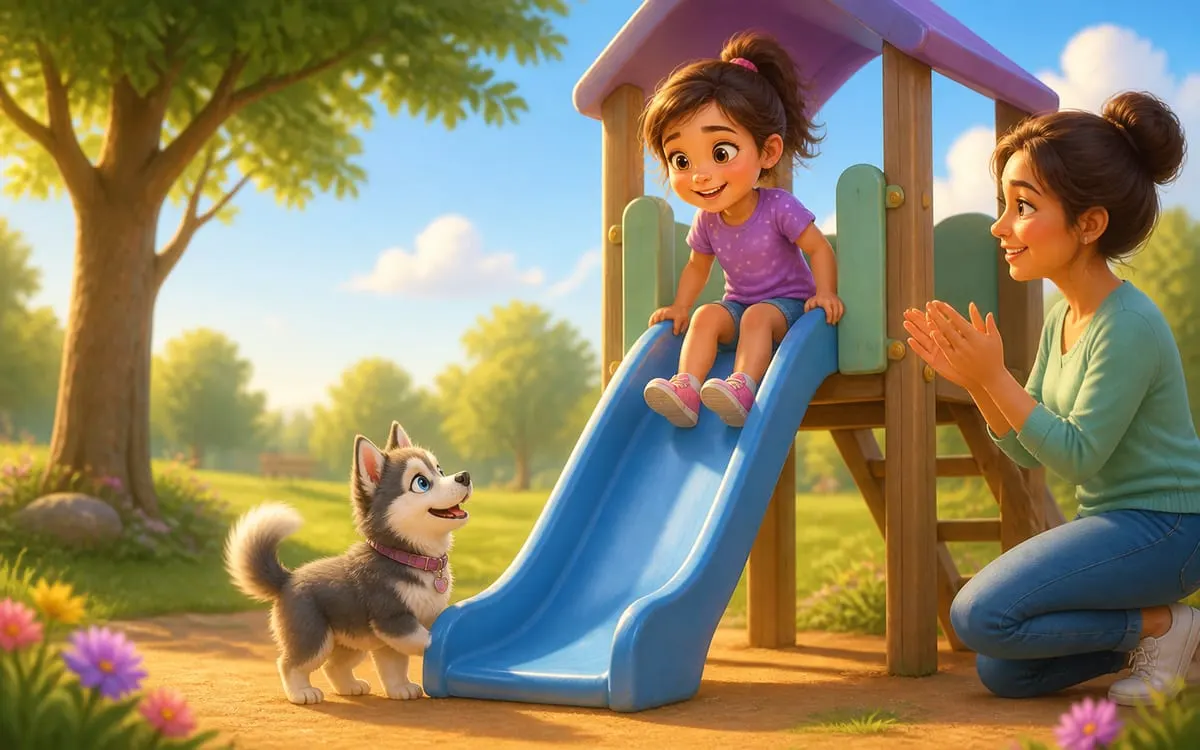
Learning to be brave is not a straight line, and days of retreat are part of the path. If your child could not climb that slide today, that is fine, tomorrow will be a fresh chance. Avoid comparing your child to siblings or classmates, because each one has their own pace. What matters is steady movement, however small it may be. Offer a hug in the hard moments and remind them that you believe in them. This parental confidence works like an invisible safety net: knowing there is somewhere to return to, a child feels free to risk a little more each day.
That is exactly why we love introducing Pigúiça, the little Siberian husky puppy from Dogavios. Even when she feels a little scared, she explores the Magic Garden and discovers that courage grows with every step. Children can live this adventure of friendship, courage and dreams in the book and in the free browser game starring Pigúiça, with no install and in many languages. A gentle, magical way to plant bravery in little hearts.
Your next adventure could be a moment together.
Now that you have met Pigúiça here, discover the story behind her world. See the illustrations, read the beginning and choose a book to share with your child, one page at a time.