Your next adventure could be a moment together.
Now that you have met Pigúiça here, discover the story behind her world. See the illustrations, read the beginning and choose a book to share with your child, one page at a time.
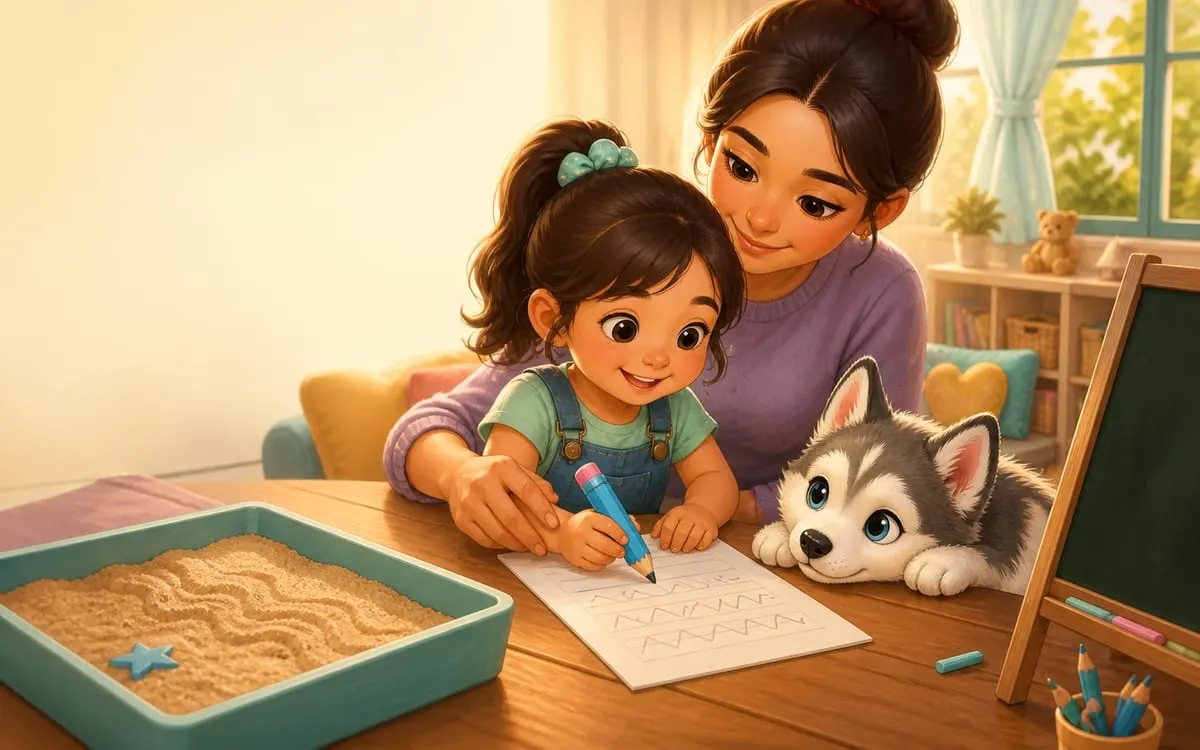
Writing your own name is the first big milestone of literacy, and also where many children meet their first frustration. Almost always for one simple reason: the hand was invited before it was ready. In the right order, it comes out naturally and without tears.
How to know it's time
Age isn't what decides, three signs are: the child can hold a pencil with three fingers, can copy simple shapes (circle, cross, square) and recognizes the first letter of their own name on sight. Without those three, practice turns into a fight. It usually happens between 4 and 6, with huge and normal variation.
The order that works
- 1. The first letter only. It's their favorite and becomes a personal symbol. Hunt for that letter on signs, packages and books.
- 2. Big letters, all capitals. Capitals are made of straight lines and simple curves, far easier than cursive. Start there.
- 3. In the air, before the paper. Write the name with a finger in the air, in sand, in flour on a tray, on a steamy window. The movement enters through the body before it enters through the pencil.
- 4. Tracing over. Write the name in light highlighter and let your child trace it. It's the scaffold they'll drop on their own.
- 5. Copying alongside. You write on top, they write below, looking at yours.
- 6. Alone, from memory. Only here, and without erasing anything they produce.
6 activities that teach without feeling like a lesson
- Play dough name: rolled snakes become letters, and the hand works hard.
- Stamped name: letters cut into a potato or foam, dipped in paint.
- Sticker name: pressing dots along the outline of each letter.
- Label the world: write their name on the toy box, the water bottle, the finished drawing. Writing gains a real purpose.
- Name on the birthday cake: draw it with a finger in the frosting, then lick the finger.
- Sign the artwork: every finished drawing gets signed underneath. It becomes a ritual, and rituals teach.
Common grown-up mistakes
- Starting with cursive. It's pretty, but it demands control that isn't there yet.
- Correcting wobbly letters. At this stage, writing at all is the win. The shape settles with time.
- The whole long name at once. If the name is long, start with a short nickname. Nobody learns «Alexander» before «Alex».
- Turning it into homework. Five cheerful minutes always beat thirty forced ones.
What comes with it
Everything that strengthens the hand speeds this stage up: dough, cutting, and above all coloring, because coloring trains the same pincer grip and outline control that writing will demand. If you want big figures for this stage, you can color online for free or use the Dogavios coloring book, drawn for hands aged 2 to 8. ✍️
Your next adventure could be a moment together.
Now that you have met Pigúiça here, discover the story behind her world. See the illustrations, read the beginning and choose a book to share with your child, one page at a time.