Your next adventure could be a moment together.
Now that you have met Pigúiça here, discover the story behind her world. See the illustrations, read the beginning and choose a book to share with your child, one page at a time.
“How was your day?” “Fine.” “What did you do?” “Nothing.” If that exchange sounds familiar, it isn't a sign of weak connection. Big, direct questions tend to freeze children, they can't summarize a whole day yet, and naming feelings takes vocabulary that's still being built. The good news: there are far more effective ways to open that door.
Questions that actually work
- Get specific: “Who sat next to you at lunch?” works much better than “how was school?”
- Use extremes: “What was the best part of today and the worst part?” Contrast helps organize memory.
- Ask about others: “Did anyone get upset in class today?” Talking about someone else is a safe route to talking about yourself.
- Use a scale: “One to ten, how was today?” Then: “what would have made it an eight?”
- Accept silence: “It's okay not to want to talk right now. I'm right here.” That keeps the door open.
Create moments, not interrogations
- Talk side by side: in the car, washing dishes, on a walk. Without direct eye contact, kids say far more.
- A nightly ritual: everyone shares one good thing and one hard thing from the day. Go first, your child copies the model.
- Grow the vocabulary: beyond happy, sad and mad, introduce frustrated, embarrassed, nervous, relieved, proud, disappointed.
- Link feelings to the body: “When you get nervous, what happens in your tummy?” That builds self-awareness.
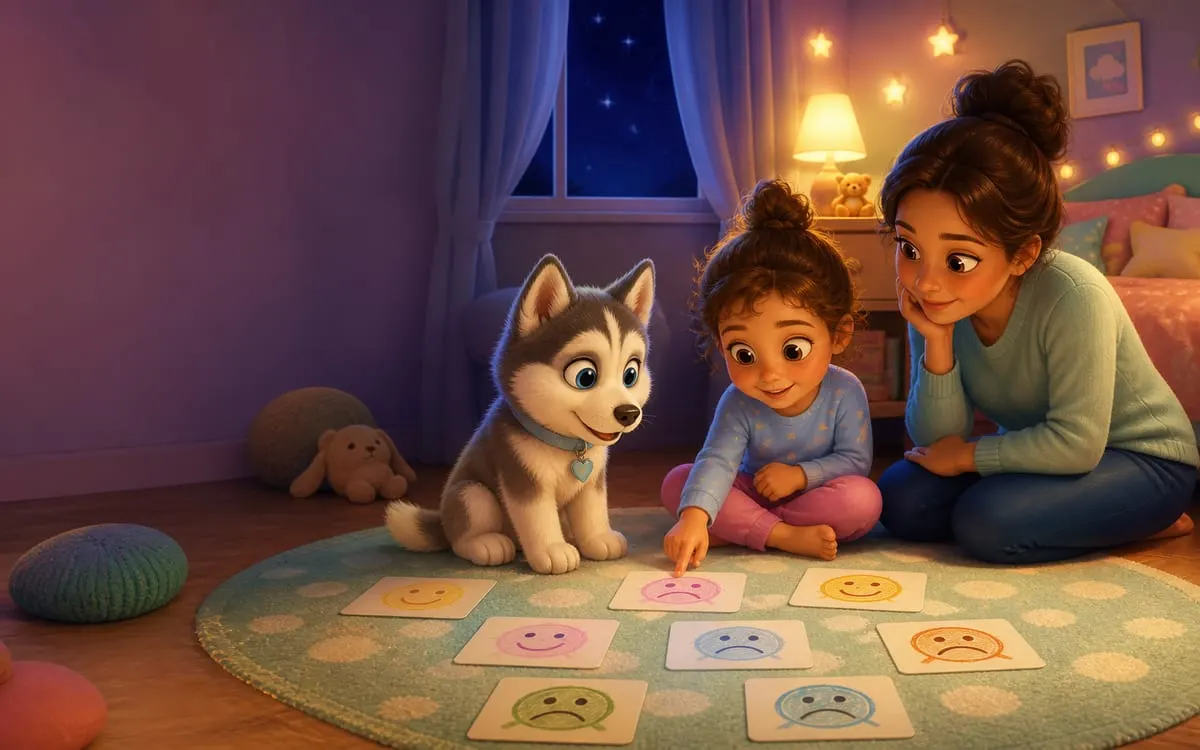
- Use drawing and play: many children will tell a stuffed animal what they won't tell your face.
What to avoid
- Correcting the feeling: “there's no reason to be sad about that” teaches kids to hide.
- Fixing too fast: before offering a solution, try “ugh, that must have felt awful.”
- Interrogating at pickup: right after school, kids are drained. Wait until bath time or dinner.
- Reacting with alarm: if everything they tell you shocks you, they'll start filtering what they tell you.
- Share your own feelings in kid size: “I got nervous at work today, so I took three deep breaths.” Naming your own emotion and your own strategy teaches more than any question you could ask.
- Don't make it mandatory: if your child doesn't want to join the bedtime ritual, that's fine. The freedom to pass is exactly what makes them want to talk on another night.
One last shortcut that works remarkably well: talk about a character's feelings instead of theirs. While reading, pause and ask, “what do you think she's feeling right now?” and then, “have you ever felt that?” That's why stories like Dogavios help so much: following the husky Pigúiça through the Magical Garden gives children a safe place to recognize their own hearts, and, without noticing, to start the conversation you were hoping to have.
Your next adventure could be a moment together.
Now that you have met Pigúiça here, discover the story behind her world. See the illustrations, read the beginning and choose a book to share with your child, one page at a time.