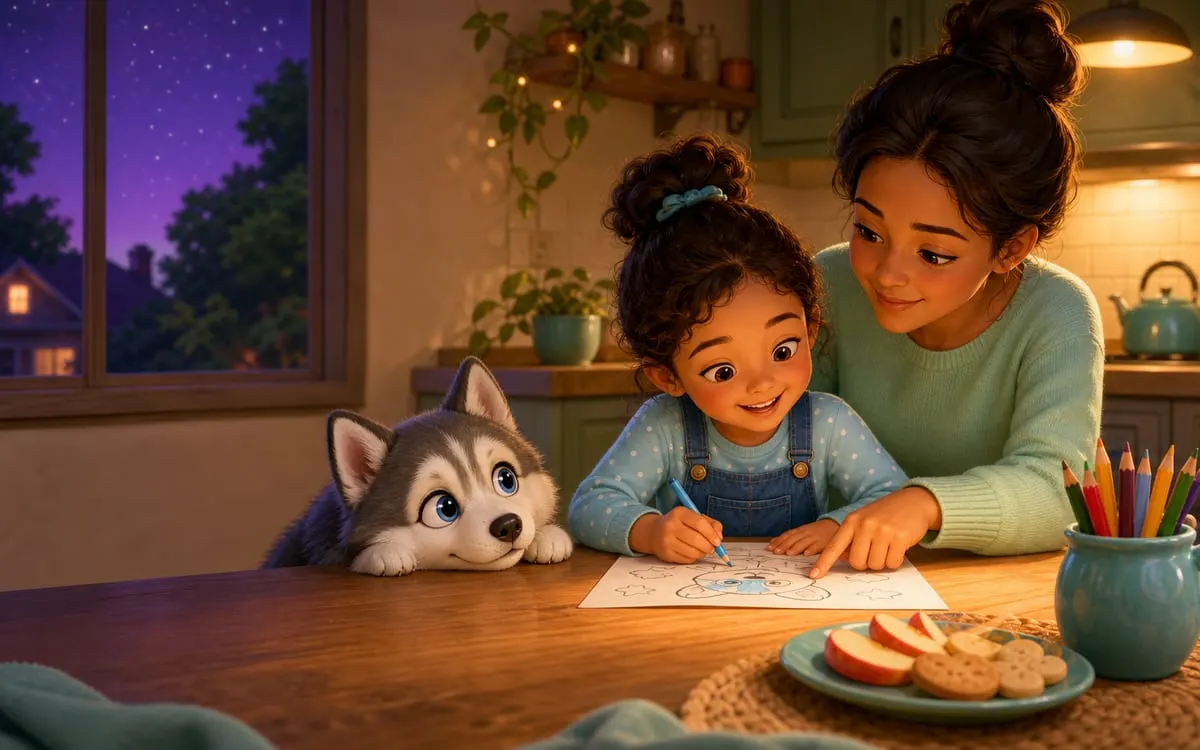
Your next adventure could be a moment together.
Now that you have met Pigúiça here, discover the story behind her world. See the illustrations, read the beginning and choose a book to share with your child, one page at a time.
The scene is nearly universal: six in the evening, everyone tired, the notebook open on the table and patience running out on both sides. The good news is that most homework fights aren't about a child being unwilling, they're about a bad time slot, an assignment that's too long for that age, and an adult who, without meaning to, ends up doing the work.
Fix the setting before you fix the behavior
- Pick the energy hour, not the leftover hour: try right after the afternoon snack, or even before school if your child has afternoon classes. After dinner almost never works.
- One fixed, low-stimulation spot: the kitchen table is fine, as long as the TV is off and phones are out of the room, yours included. Put water, a sharpened pencil and an eraser on the table before you start, to kill the strategic trips to the kitchen.
- Break it into blocks with a kitchen timer: ten to fifteen minutes of work, three minutes to drink water or jump around. Watching time move visibly cuts the "this never ends" feeling.
Help without taking over
- Stay close but busy: fold laundry or chop vegetables at the same table. Your presence is calming; your pen correcting everything removes their ownership.
- Answer with a question: instead of "it's five," try "where could you look that up?" or "walk me through how you started." Explaining out loud unsticks half of all stuck moments.
- Let mistakes survive: a notebook with errors is useful information for the teacher. If you polish everything, nobody finds out where support is needed.
- Set a time cap with the school: if a twenty-minute assignment eats ninety minutes, that's data. Send the teacher an honest note.
When the fight is about something else
- Constant avoidance can hide a difficulty: a child who always "forgets" the notebook or gets a stomachache at homework time may be dodging something they genuinely can't do.
- Separate reading from content: if they understand when you read aloud but stall reading alone, the obstacle is decoding, not the subject.
- Talk to the school: persistent struggle deserves assessment, not more pressure.
And remember learning doesn't only happen on paper. Twenty minutes of reading for pleasure at night does more for vocabulary and comprehension than an extra worksheet, Pigúiça's adventures in Dogavios work well precisely because children read without feeling like they're studying.
Your next adventure could be a moment together.
Now that you have met Pigúiça here, discover the story behind her world. See the illustrations, read the beginning and choose a book to share with your child, one page at a time.