Your next adventure could be a moment together.
Now that you have met Pigúiça here, discover the story behind her world. See the illustrations, read the beginning and choose a book to share with your child, one page at a time.
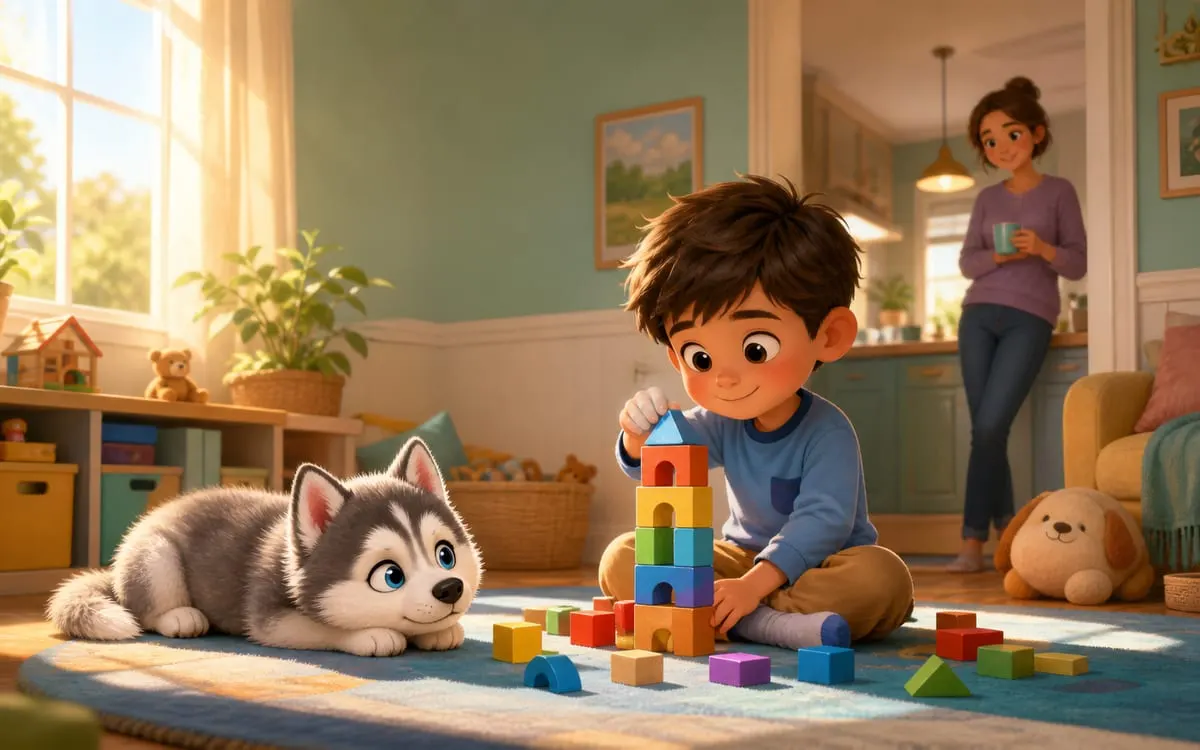
Every parent knows the scene: you sit down to work, the house is full of toys, and your child still appears every thirty seconds announcing they are bored. The good news is that playing alone is not a gift some children have and others lack, it is a skill you train, like riding a bike. And it trains in minutes, not hours.
The five-minute method
- Start together, leave gradually: sit on the floor and genuinely play for five minutes, phone away. Then announce: I am going to fold laundry, back soon. Leave for three minutes and return before you are called. Returning early is the trick, it proves you always come back, and the anxiety fades.
- Add two minutes at a time: next week five minutes away, then eight, then fifteen. A four-year-old trained this way comfortably reaches twenty or thirty independent minutes within about a month.
- Agree on a return signal: a kitchen timer on the table beats a verbal promise. When it beeps, you appear. No exceptions, or the deal loses its value.
- Praise the creation, not the silence: instead of thanks for being quiet, say you built a bridge out of cushions. The focus lands on what they made, not on the trouble they did not cause.
Set the stage in your favour
- Fewer toys on display: keep six to eight options within reach and rotate the rest from a box every fortnight. Too much choice paralyses, and a toy that disappears for two weeks comes back feeling brand new.
- Play invitations: before bed, set up a ready-made scene on a low table, dinosaurs among dry leaves, cars and a roll of masking tape becoming a road. Your child wakes up and play has already started itself.
- A loose parts box: tubs, lids, fabric scraps, corks, string, shoeboxes. Material with no fixed purpose sustains far more time than a toy that does one thing.
- Somewhere the mess can stay: a rug or corner where a construction can survive until tomorrow. Play that must be tidied in ten minutes never gets deep.
When they call you constantly
- Answer without solving: instead of demonstrating, hand the question back: what if you tried it from the other side? Thinking restarts instead of waiting.
- Fill the tank first: fifteen minutes of undivided attention before you need to work is worth more than an hour shared with your phone.
- Let boredom happen: the two or three minutes of complaining are exactly when imagination switches on. Hold your nerve before offering a solution.
And for the days when you truly need a solid half hour, a calm plan B helps: Pigúiça's free game, from the blue-eyed husky of Dogavios, opens straight in the browser with nothing to install and no ads popping up, your child runs, jumps and collects stars entirely on their own.
Your next adventure could be a moment together.
Now that you have met Pigúiça here, discover the story behind her world. See the illustrations, read the beginning and choose a book to share with your child, one page at a time.