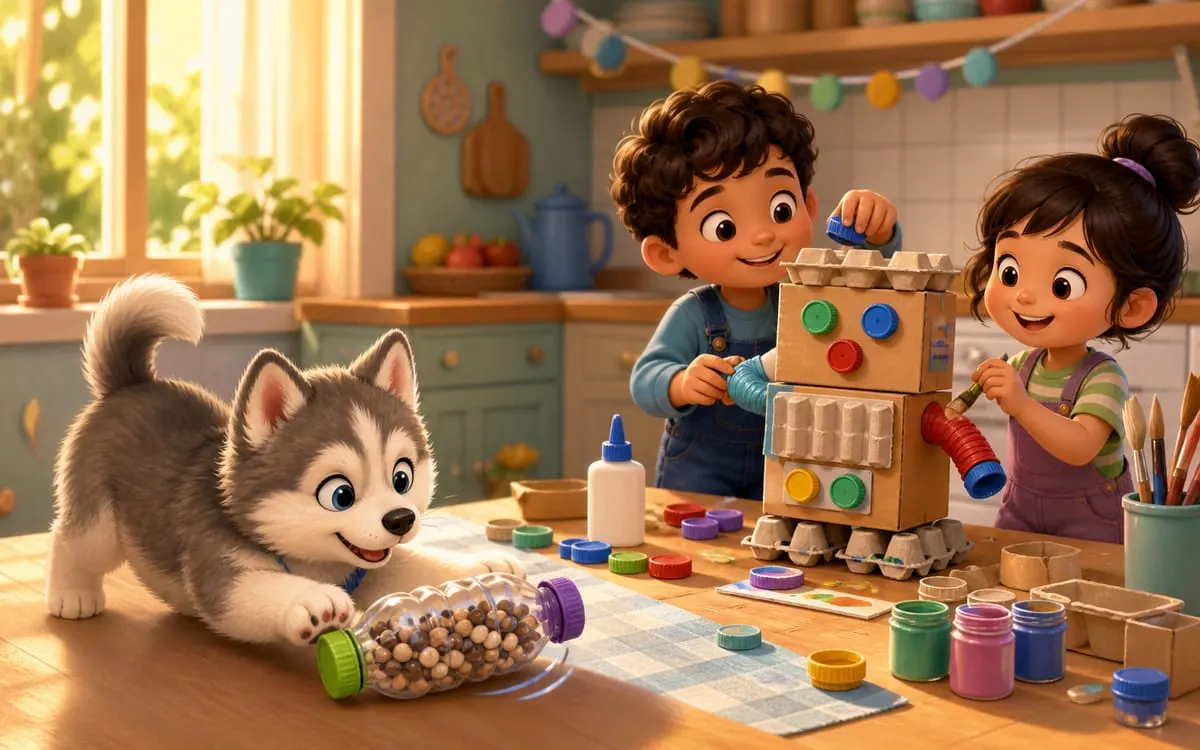
Your next adventure could be a moment together.
Now that you have met Pigúiça here, discover the story behind her world. See the illustrations, read the beginning and choose a book to share with your child, one page at a time.
To get kids to clean up toys, turn tidying into a short game with a clear start and finish, and do it together at first. Little ones rarely respond to “clean your room”, but they love “let's see who finds all the cars before the song ends”. Here are 10 games to try today.
Toy cleanup race: 10 ready-made games
Pick one, announce it, and play for 5 to 10 minutes. Nobody runs with objects in hand, and nobody carries toys up or down the stairs: the game is about finding and putting away, not about risky speed.
- Beat the song: play a song your child likes. The challenge is to clear the floor before it ends. If it doesn't work, try again, with no losing score.
- Pigúiça only picks up blue: name a color and your child puts away only the toys of that color. Then Pigúiça asks for red, then yellow, and so on until the floor is clear.
- Rug treasure hunt: pretend the floor is a sea and every toy is a treasure that must go back in the chest. Who finds the best-hidden treasure?
- Moving truck: the basket is the truck and your child is the driver. Each trip carries one kind of toy, blocks first, then cars, to the garage, which is the box.
- Fofuxo tucks in the stuffed animals: the plushies are sleepy, and Fofuxo, the golden retriever, needs to put them to bed in the box one by one, with a whispered good night.
- Every toy goes back to its little house: each box is a little house. Ask “where does this one live?” and your child takes the toy home and closes the door gently.
- Counting out loud: agree on a goal, say 10 toys, and count together as each one goes in the box. For older kids, count by twos or backwards.
- Dance and freeze: while the music plays, everyone puts away one toy at a time. When you pause the music, everybody freezes like a statue. When it comes back, they put away one more.
- Plushie basketball: stuffed animals and sock balls go into the laundry basket, one step away. Only soft toys and short, gentle throws.
- Missing toy detective: say “I'm looking for a round toy” and your child finds it and puts it away. Then switch roles: now your child gives you the clue.
A tidy-up song
Sing it to the tune of “Twinkle, Twinkle, Little Star”, a traditional public-domain melody. The words are ours, and the second verse can close the cleanup.
Verse 1: One, two, three, here we go, / toys go home, nice and slow. / Ball in basket, bear in bed, / Fofuxo nods his happy head.
Verse 2: Floor is clear, the room is neat, / tidy up feels extra sweet. / All back home, hooray, hooray, / time to play another day.
How to set up the room so it's easier
A lot of mess is not unwillingness, it's a lack of places. If putting away means stacking, lifting a heavy lid or guessing where things go, kids give up.
- Boxes with pictures: stick a photo or drawing of the contents on the front of each box. Kids who can't read yet can still put things away alone.
- Fewer toys out: keep only part of the collection within reach. Fewer choices, fewer piles on the floor.
- Rotation: store the rest on a high shelf and swap every 2 or 3 weeks. What was hidden comes back feeling new.
- Low shelves and open boxes: at your child's height, with no hard lids. You can even make baskets and boxes at home, and there are ideas in easy homemade toys.
What to expect at each age
Ages 3 to 4
They need you right there. Ask for one task at a time, like “put the cars in the box”, instead of “clean everything”. Expect help, not a spotless room.
Ages 5 to 6
They understand boxes by type and enjoy game rules. Colors, counting and music work well here. They put away a good part alone, and you just check at the end.
Ages 7 to 8
They can look after their own room with a simple agreement, like tidying before dinner. Let them choose how to organize the boxes. Prefer an agreed reminder over a scolding.
When your child says no
Refusal is common, especially when tired or hungry. Don't use punishment, don't threaten to throw the toys away, and don't shame your child. Try this:
- Tidy together and say who does what: “I take the blocks, you take the cars.”
- Offer a choice: “do you want to tidy with music or by counting?”
- Shrink the task: just one kind of toy is already a win.
- Describe the effort: “you put away every single car.” No candy as a prize.
- Put tidying in the routine: as the last step before dinner or in the bedtime routine, it stops being a surprise.
With the floor clear, how about coloring a page together? And if your child likes Pigúiça and Fofuxo, they live in the book Dogavios.
Frequently asked questions
At what age do kids start putting toys away?
Around 2 and a half or 3, they can help with simple requests, always next to an adult. Independence grows little by little, up to 7 or 8 years old.
How long should cleanup take?
Between 5 and 10 minutes, with a game. If your child is tired, they put away only part and you finish, with no comments.
Should I reward my child for tidying up?
Prefer to notice the effort and spend a little time together afterward. Putting away is part of life at home, and it doesn't need candy or payment to count.
Your next adventure could be a moment together.
Now that you have met Pigúiça here, discover the story behind her world. See the illustrations, read the beginning and choose a book to share with your child, one page at a time.