Your next adventure could be a moment together.
Now that you have met Pigúiça here, discover the story behind her world. See the illustrations, read the beginning and choose a book to share with your child, one page at a time.
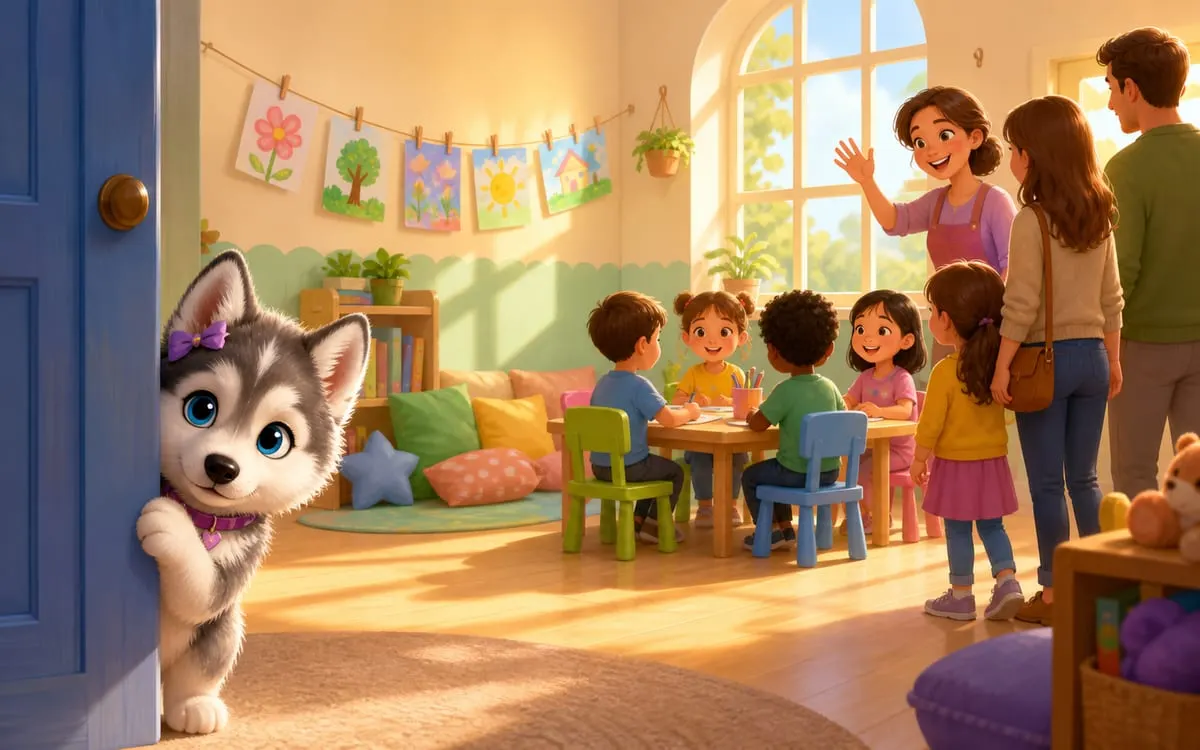
Choosing a preschool scrambles your brain because nearly all the available information is the least important kind: tuition, distance, covered sports court, robotics for toddlers. What determines whether a child will thrive there is far simpler and far less visible in the brochure, it's how the adults speak to children when nobody's watching.
What to observe on the tour
- Visit during class hours, not when it's empty: ask to come while children are there. An empty school is a stage set, not reality.
- Listen to the adults' tone: do teachers crouch to speak at the child's eye level? Use names? Correct firmly without shaming? That is the single most important data point of the whole visit.
- Study the walls: is the displayed work all identical and template-made, or does each piece look like a different child made it? Excessive uniformity signals over-directed activity.
- Check the outdoor space: room to run, dirt, water, shade? Young children learn through their bodies. A tiny yard is a serious limitation.
- Count adults per group: ask for the real number, including assistants, and what happens when someone calls in sick.
Questions that reveal a lot
- "What do you do when a child bites or hits?" The answer exposes the whole philosophy: punishment, time-out corner, or mediation and naming emotions.
- "How does settling in work?" A school that offers gradual entry and lets families stay the first days understands child development.
- "What's your teacher turnover over the past two years?" High churn usually means poor working conditions, and broken bonds with the children.
- "How do you communicate with families?" Look for a clear channel and individual meetings, not just pretty photos in an app.
- "How long do children sit still?" In early years, play isn't a break from learning, it is the learning.
Red flags worth taking seriously
- Reluctance to show you the classroom: a good school is proud of what it does.
- Promises to teach reading very early: selling literacy at four as a selling point usually means pressure, not quality.
- Children who are too quiet: an early years room has the noise of happy people. Total silence is a yellow flag.
- Your own discomfort: if you left with a knot in your chest you can't explain, go back another day before deciding.
In the end, trust what you know about your own child too: an energetic kid needs space and movement; a more reserved one does better in a small group. There's no perfect school, but there is the one that fits this child. While you decide, reading together every day remains the best educational investment there is, and Pigúiça's stories, available in 18 languages, work nicely for bilingual-school families too.
Your next adventure could be a moment together.
Now that you have met Pigúiça here, discover the story behind her world. See the illustrations, read the beginning and choose a book to share with your child, one page at a time.