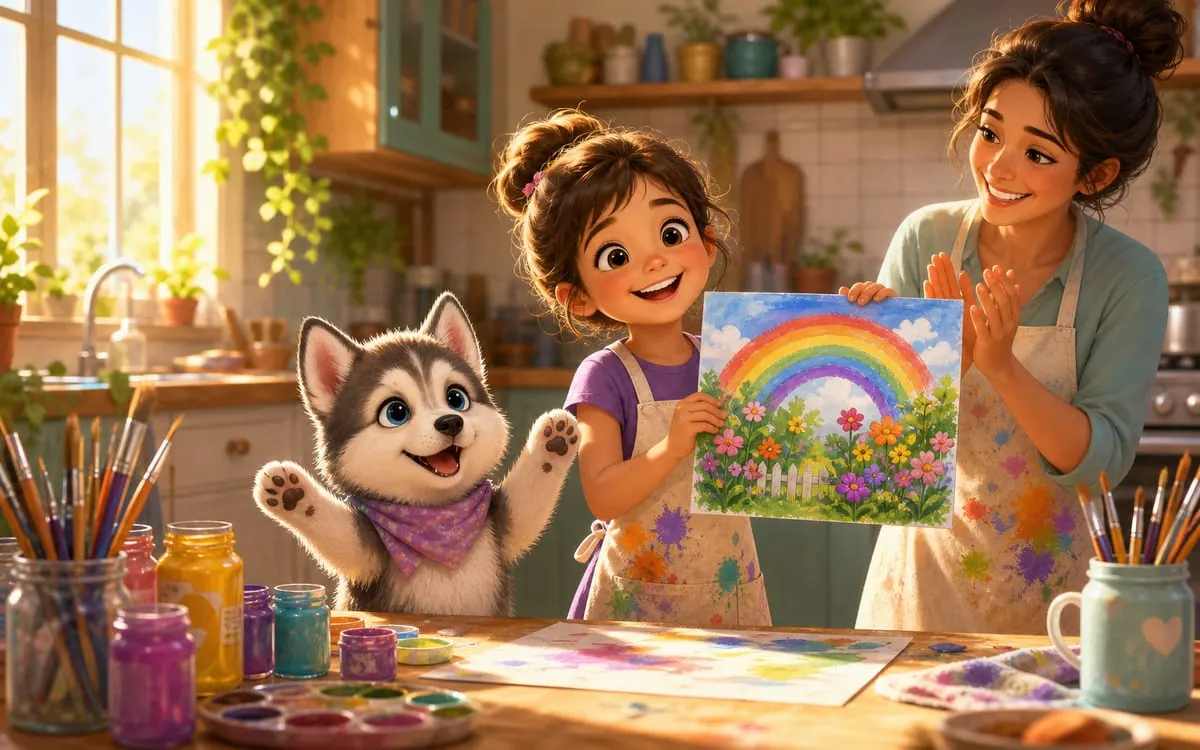
Your next adventure could be a moment together.
Now that you have met Pigúiça here, discover the story behind her world. See the illustrations, read the beginning and choose a book to share with your child, one page at a time.
Many parents try to build self-esteem with praise: “you're beautiful,” “you're the best,” “what a genius.” The intention is lovely, but the result tends to be fragile. Solid self-esteem doesn't come from hearing you're amazing. It comes from three things: feeling capable, feeling loved exactly as you are, and feeling you belong. The good news is that all three can be built at home, with zero motivational speeches.
Swap generic praise for specific praise
- Describe what you saw: “You used three different blues for the sky” instead of “beautiful!” Your child learns you actually looked.
- Praise effort and strategy: “You kept trying until it worked” builds more confidence than “you're so smart.”
- Notice character, not just talent: “You told the truth even though you knew there'd be a consequence.”
- Avoid comparisons: “better than your brother” creates self-worth that depends on someone else losing.
Give real responsibilities
Nothing builds confidence like doing real things that actually work. Competence is the foundation.
- Jobs with visible impact: setting the table, watering plants, picking the fruit at the store.
- Let mistakes stand: if the bed is lumpy, leave it lumpy. Redoing it in front of them says “you're not capable.”
- Teach instead of doing: fifteen minutes teaching them to open the bottle beats two years of opening it for them.
- Ask their opinion: “Which way should we go?” Being consulted makes a child feel like someone who counts.
Phrases that hold self-esteem up
- When they mess up: “Making a mistake doesn't change one bit how much I love you.”
- When they compare themselves: “Everyone learns at their own pace. Your pace is the right one for you.”
- When they give up: “You haven't got it yet. Want to try a different way?”
- At bedtime: “What did you do today that you feel proud of?” This teaches them to look at themselves generously.
- For no reason at all: “I like talking with you.” Unconditional love, said casually.
- Keep a folder of their work: old drawings and early writing show concrete progress. “Look how you wrote last year” is visual proof that they're someone capable of growing.
- Let them teach you something: ask them to show you how their game works or how to draw a dinosaur. Being the expert in front of an attentive adult is an enormous confidence boost.
- Watch the family nicknames: “the messy one,” “the crybaby,” “the clumsy one” stick for years. Describe the moment instead of defining the person.
And watch how you speak about yourself: children learn self-esteem by observing how adults treat their own mistakes. If you say “I'm so stupid” every time you slip, that's the script they'll copy. Stories help too: in Dogavios, the husky Pigúiça discovers in the Magical Garden that the things that make her different are exactly what make her her, and children absorb that without anyone having to say “you're special.”
Your next adventure could be a moment together.
Now that you have met Pigúiça here, discover the story behind her world. See the illustrations, read the beginning and choose a book to share with your child, one page at a time.