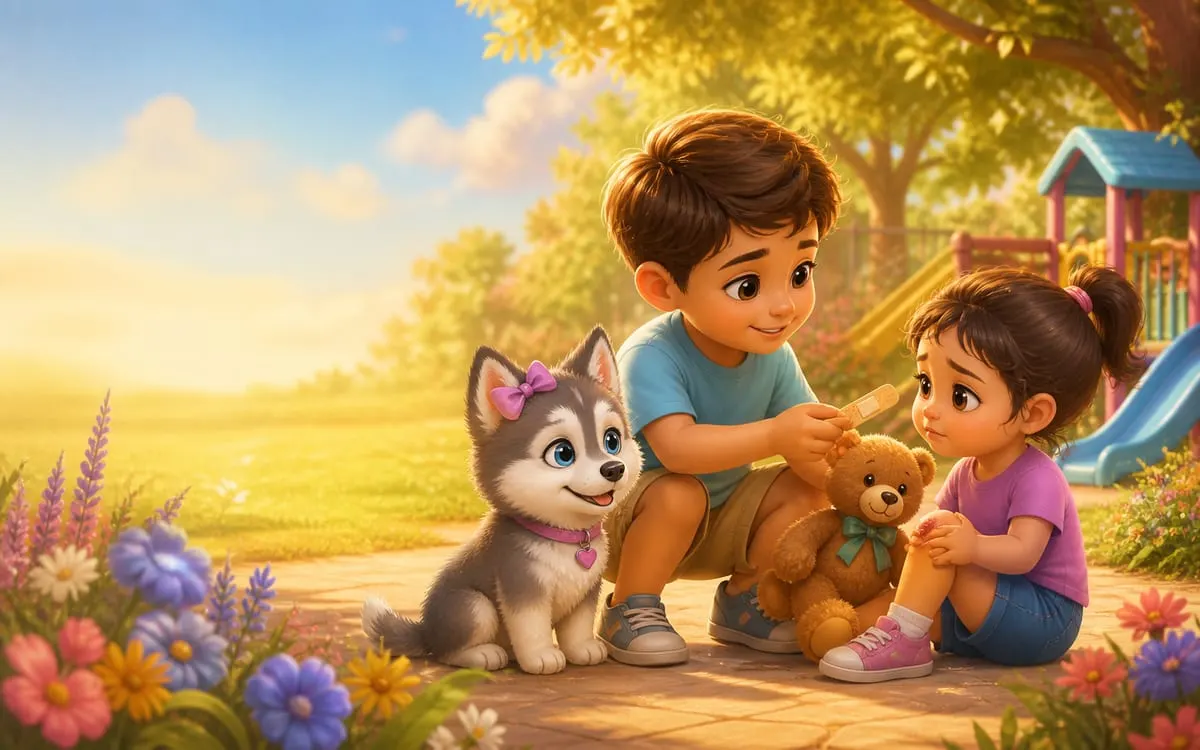
Your next adventure could be a moment together.
Now that you have met Pigúiça here, discover the story behind her world. See the illustrations, read the beginning and choose a book to share with your child, one page at a time.
Every parent wants a child who notices other people. What nobody mentions is that empathy doesn't grow from speeches, it's built through repeated micro-moments. Before about age six, the brain still struggles to hold someone else's perspective. That's maturation, not selfishness. What we can do is offer many chances to notice, feel and act for someone else, without turning it into a moral demand.
Practices that train empathy
- Narrate other people's emotions out loud: “Look at that boy, he's crying. What do you think happened?” Noticing comes before caring.
- Play face detective: on the street or at the park, guess together how people feel based on their faces and posture.
- Ask questions during books: pause and ask, “how do you think he felt when that happened?”
- Give caretaking jobs: watering the plant, feeding the dog, bringing water to a sibling. Caring builds the muscle faster than any conversation.
- Validate their feelings first: a child who feels understood at home has far more capacity to understand others. Empathy is learned by receiving it.
Phrases that help (and ones that don't)
- Instead of “say sorry right now”: try “look at his face. How do you think he's feeling?”
- Instead of “you're being selfish”: try “Leo wanted to play too. How can we solve this?”
- Instead of “don't be like that”: try “what do you think would help him feel better?”
- After a kind act: “You saw she was sad and you went over. That really mattered to her.” Naming the effect beats “how cute.”
What to avoid
- Forcing affection: requiring hugs or kisses teaches compliance, not consideration.
- Shaming in public: shame shuts a child down and blocks the very thinking you're asking for.
- Expecting too much for the age: at three, sharing is genuinely hard. Demand less and demonstrate more.
- Teaching with words only: children copy how you treat the delivery driver, the neighbor, your partner. Your behavior is the curriculum.
- Swap roles in pretend play: “now you're the doctor and I'm the patient who's scared.” Standing in someone else's shoes inside make-believe is one of the most effective empathy workouts available in early childhood, and kids ask to do it again.
- Notice who's left out: at the park, point to the child sitting alone and ask, “do you think she wanted to play with us?” Spotting who's outside the group is a social skill learned through gentle repetition.
Stories are a powerful shortcut, because they place a child inside another character's chest with zero risk. That's exactly what happens in Dogavios: following the husky Pigúiça and her friends through the Magical Garden, children feel before they judge, and feeling first is how empathy actually takes root.
Your next adventure could be a moment together.
Now that you have met Pigúiça here, discover the story behind her world. See the illustrations, read the beginning and choose a book to share with your child, one page at a time.