After the game, discover the story together.
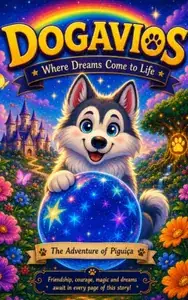
Pigúiça also has an illustrated adventure to read together. Explore real pages, read the beginning free and check the complete edition if you would like to continue.
Creativity is not a talent handed out in a genetic lottery, it is a muscle that responds to training. And the training has one clear feature: the less the material decides what to do, the harder the mind has to work. A toy that talks by itself delivers everything ready-made; a cardboard box demands a decision every minute. The games below work exactly that.
Storytelling games
- Story dice: draw simple symbols on the six faces of three paper cubes (a key, a moon, a dog, a door, a star, a wave). Each player rolls all three and must stitch together a story using all three symbols. Two to six players, fifteen minutes.
- What if: one player starts with an impossible question, what if it rained jelly?, and everyone in the circle adds a logical consequence inside that mad world. Works from about age four upwards.
- Story with compulsory objects: your child picks three objects from around the house and the adult has to tell a story using all three. Then swap. The swap is the part that teaches most.
- Finish the scribble: one person makes a random squiggle, the other turns it into something recognisable. Take turns. Five minutes a round, and the sheets become a collection.
Building and loose parts games
- The bridge challenge: using newspaper and masking tape, build a bridge spanning 30 cm between two books that can hold a toy car. Two teams, twenty minutes on the clock. The interesting part is seeing two different solutions at the end.
- The thousand-use box: hand over a big cardboard box without saying what it is. Suggest nothing. If your child freezes, ask only: what could this be if it were not a box?
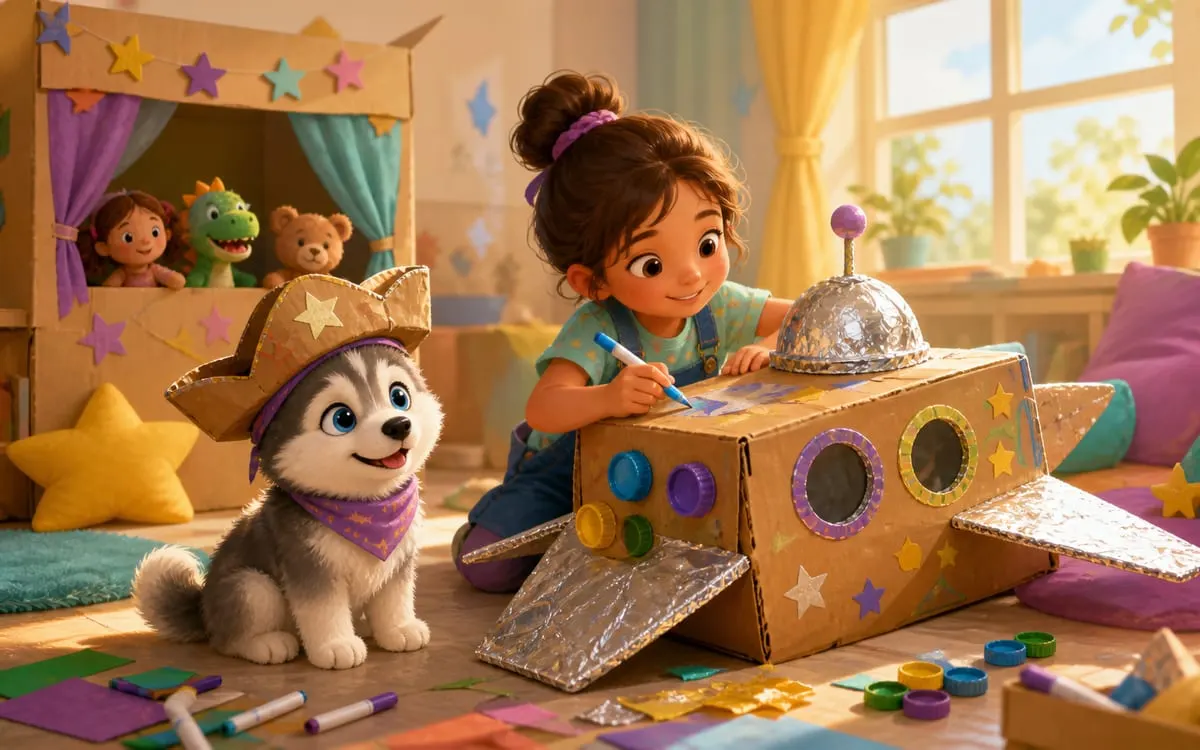
- Junk invention: cardboard tubes, bottle caps, sticks, string, glue. One rule only: the invention must have a name and do something, however absurd.
Questions that unlock imagination
- How many uses: pick an everyday object and list twenty different uses for it together in three minutes. The first five are obvious; real creativity starts around the tenth.
- What happened before: show a picture from a book and ask what happened five minutes before that scene. Then what happens after the last page.
- Change the ending: reread a familiar story and ask for a new ending where the character makes the opposite decision.
One tip beats all the others: resist correcting. If your child says the dog flies, the good answer is and how does he land?, not dogs cannot fly. Imagination grows where it is not interrupted. That same spirit drives Pigúiça, the blue-eyed husky from Dogavios, through the Magical Garden in the book and in the free browser game that needs no install.
After the game, discover the story together.
Pigúiça also has an illustrated adventure to read together. Explore real pages, read the beginning free and check the complete edition if you would like to continue.