Your next adventure could be a moment together.
Now that you have met Pigúiça here, discover the story behind her world. See the illustrations, read the beginning and choose a book to share with your child, one page at a time.
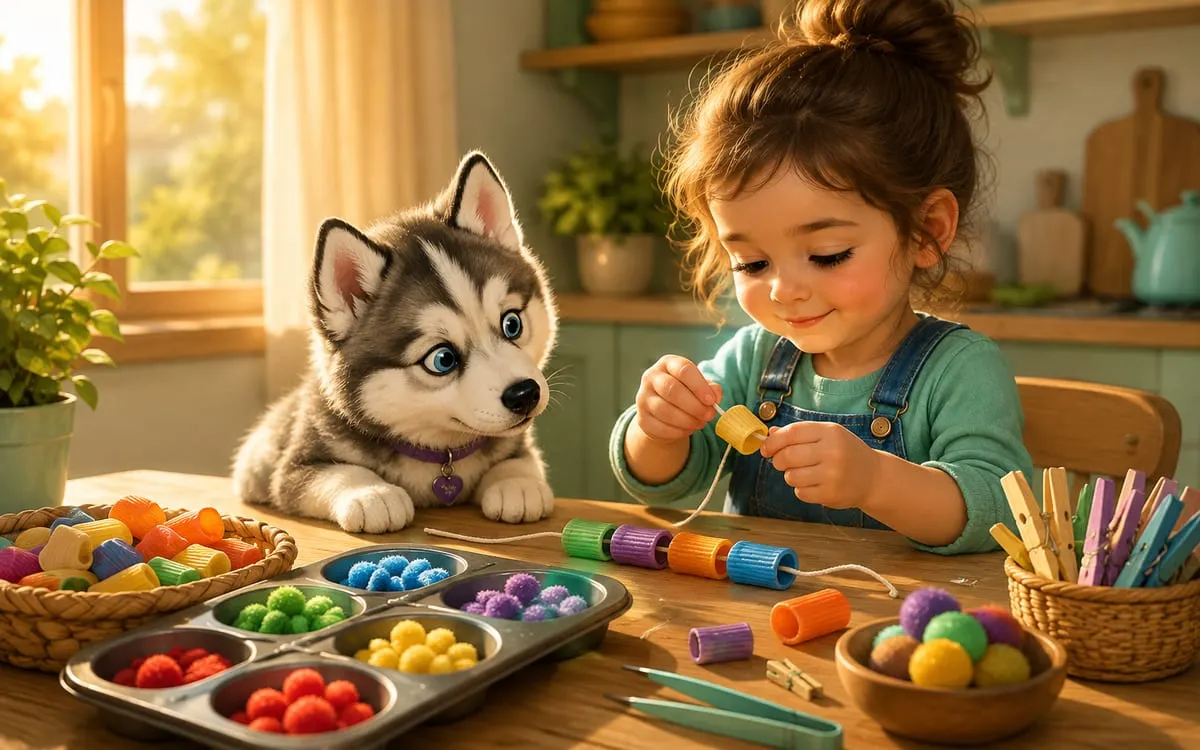
When a child writes two lines and complains their hand hurts, laziness is rarely the issue. Writing demands finger strength, wrist stability and eye-hand coordination, all of which are built through play, long before the notebook. The good news: almost none of it requires anything you'd have to buy.
Strength and pinch: the fingers that hold the pencil
- Clothespins: have them clip pegs around the rim of a shoebox or along a string line. Opening a peg uses exactly the muscles of a pencil grip.
- Tong transfers: move cotton balls, beans or pompoms from one bowl to another with kitchen tongs or tweezers.
- Resistant playdough: squeeze, roll, pinch off bits, and hide beads inside for them to dig out. The stiffer the dough, the harder the hands work.
- Spray bottle: let them water plants or "clean" a window. Squeezing the trigger is excellent training.
- Tearing magazine paper: ripping thin strips requires two coordinated hands, and it's pure catharsis for kids.
Precision and eye-hand coordination
- Pasta necklaces: thread penne or cut straws onto string with a masking-tape tip.
- Cardboard sewing: punch holes around a piece of box with a pencil and let them "sew" with a shoelace. A solid thirty-minute toy.
- Unrushed scissors: start by snipping straws into rings (single easy cuts), then thick straight lines, then curves. Round-tip scissors and supervision, always.
- Eyedropper painting: drip colored water onto paper towel and watch it bloom. Controlled squeezing plus guaranteed wonder.
- Jars and lids: gather screw-top containers of different sizes and have them match and close each one.
Fitting it into real life
- Keep a ready box: pegs, pompoms, dough and string in one reachable box. Activities that need setup don't happen.
- Lean on daily tasks: buttoning a coat, peeling a tangerine, whisking eggs, pressing the elevator button. Independence is therapy in disguise.
- Don't turn it into homework: five fun minutes a day beat a mandatory half hour.
If the hand tires very fast despite regular practice, if your child systematically avoids drawing, or if their mark-making doesn't progress at all over months, mention it to the teacher and pediatrician, an occupational therapy assessment often sorts it quickly. And in the gaps, the free Dogavios game works as light eye-hand and reaction-time practice, with Pigúiça for company.
Your next adventure could be a moment together.
Now that you have met Pigúiça here, discover the story behind her world. See the illustrations, read the beginning and choose a book to share with your child, one page at a time.