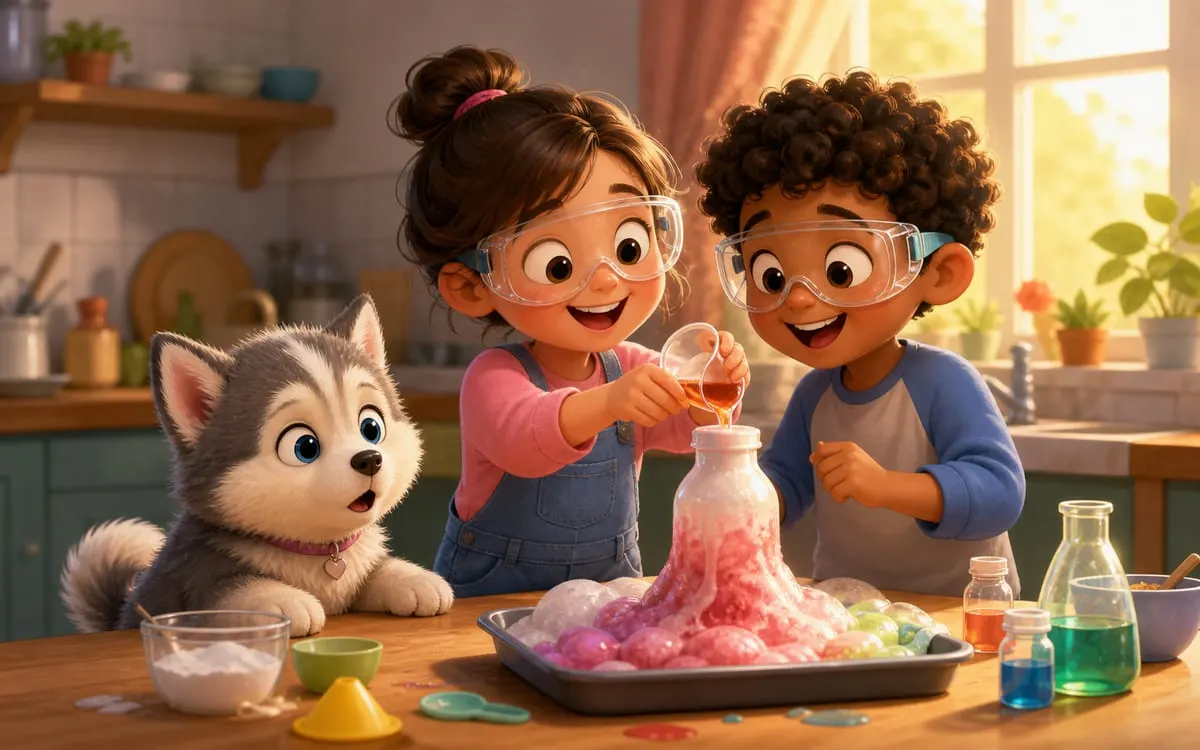
You do not need a lab to wake up the scientist inside every child, your kitchen cupboard already has almost everything you need. Simple experiments teach ideas about physics and chemistry in a way no explanation can match, because the child sees it, touches it, and above all is surprised by the result.
Baking soda volcano (age 3+)
Mix baking soda inside a small bottle and pour in vinegar tinted with red food coloring. The reaction releases carbon dioxide, which pushes foam out like lava. Keep the explanation simple: «two ingredients meet and make gas bubbles, like a giant burp!».
Oobleck: the liquid that is also a solid
Mix 2 parts cornstarch to 1 part water. The result is a non-Newtonian fluid: it drips like a liquid when left alone, but hardens when squeezed hard. It is perfect for little hands to explore textures and watch the same substance behave two different ways.
The orange that floats (and the peeled one that sinks)
Drop a whole orange in water: it floats. Peel the same orange and try again: it sinks. The peel is full of thousands of tiny air pockets that act like a natural life vest, remove the peel and you remove the fruit's «life jacket».
Rainbow in a glass of sugar water
Dissolve different amounts of sugar in four cups of colored water, then carefully layer them with a spoon, from sweetest (densest) to least sweet. The layers do not mix, forming a liquid rainbow, a visual lesson in density.
Turning this into a habit of curiosity
- Let the child predict what will happen before you do the experiment, being wrong teaches too.
- Ask questions out loud: «why do you think that happened?».
- After the scientific mess, a calm reading moment helps close out the activity, stories like Pigúiça's, who loves exploring the Magical Garden, pair nicely with that spirit of discovery.
Always supervise the use of vinegar, food coloring, and small parts, and pick experiments that match your child's age.