Your next adventure could be a moment together.
Now that you have met Pigúiça here, discover the story behind her world. See the illustrations, read the beginning and choose a book to share with your child, one page at a time.
Every child feels a great deal, yet rarely has the words for the storm going on inside. One day it is pure joy, the next a meltdown that seems to come from nowhere. This is where children's books about emotions become quiet heroes: they give a name to what the child lives and show, gently, that feeling is simply human and that no one needs to be afraid of their own heart.
Why reading about feelings matters
When a character feels fear, anger or joy and the story holds that gently, a child learns that her own emotions belong too. That recognition is the foundation of emotional intelligence: noticing what you feel, naming it and choosing what to do with it. From recognition grows the seed of empathy, because the child begins to imagine what someone else feels and to care about it.
What to look for in a good book
- Naming the feelings: the story clearly says fear, sadness, jealousy, joy, with no dodging.
- A relatable character: someone going through something close to the child's own life.
- A comforting resolution: the hard emotion is welcomed and the ending brings safety, never shame.
- Expressive illustrations: faces and gestures a child can read even before she grasps the words.
Which feelings are worth covering
No emotion is off limits. Bring in the fear of the dark or the new, the anger of a frustration, the sadness of a small loss, the joy of an achievement and even the jealousy of a sibling. The wider the range, the better a child understands her own inner world and the less she panics when a strong feeling shows up. Over the months, that emotional vocabulary becomes a compass she uses on her own.
How to read them for real impact
Reading turns to gold when you pause and ask. Try stopping at a scene and asking: how do you think the character feels right now? Have you ever felt that way? What might help her? These questions turn the book into a bridge for talking about feelings, with no rush and no pressure. Resist correcting her answers: the goal is not to be right, but to open room to talk.
Make reading a gentle routine
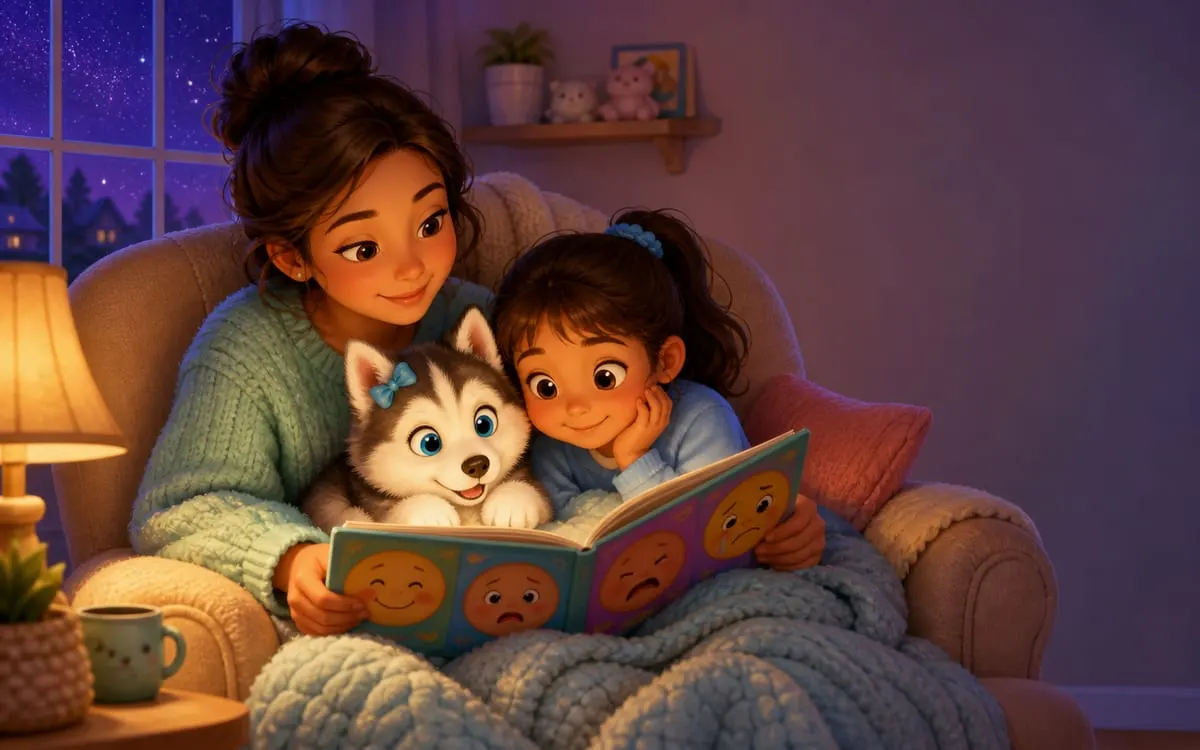
A little book before bed creates a safe space to talk about the day. In that calm moment, with the lights low and a lap nearby, a child lowers her guard and shares naturally what she felt. Reread the favorites as many times as she asks, because that familiarity is exactly what creates comfort.
If you want a warm example, meet Dogavios: Where Dreams Come to Life. Pigúiça, a sweet blue-eyed Siberian husky puppy, faces fear with courage as she explores the Magic Garden, in a story about friendship and dreams that makes the perfect bedtime read. There is even a free browser game with Pigúiça, nothing to install, to stretch the magic after the last page.
Your next adventure could be a moment together.
Now that you have met Pigúiça here, discover the story behind her world. See the illustrations, read the beginning and choose a book to share with your child, one page at a time.