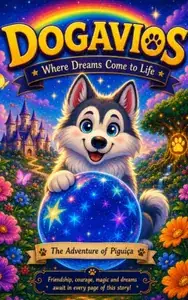
The world you follow can be part of story time too.
In the Dogavios books, Pigúiça’s adventure moves at the pace of your family’s reading. Open the sample, explore the illustrations and discover the story one page at a time.
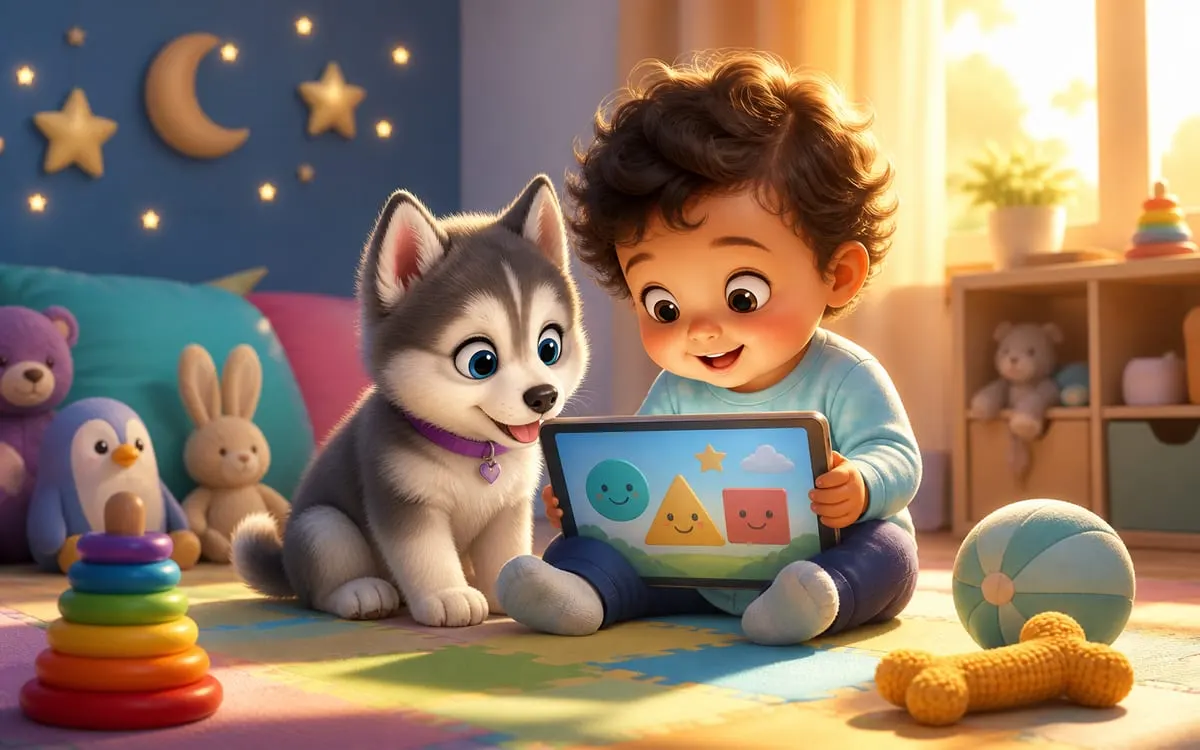
At three, your child asks for shows by name, has firm favorites, and protests loudly when you switch off. It's a lovely, exhausting age. And it's precisely the age where your choice of content matters most, because a three-year-old brain still can't cleanly separate story from pure stimulation.
What works at this age
- Episodes of 5 to 11 minutes: roughly the sustained attention span at three. Longer episodes get watched, not absorbed.
- Few characters: two or three. Large casts confuse, and a child loses the thread without noticing.
- One thing happening at a time: no parallel plots. At three, a story needs to be a straight line: wanted, tried, went wrong, fixed it.
- Repetition is welcome: if your child wants the same episode for the ninth time, let them. Repetition is how a brain at this age consolidates language and sequence. It's work, not laziness.
- Clear, unhurried speech: characters who talk too fast build no vocabulary. Ones who speak slowly build a lot.
What to avoid
- Fast cuts: if the scene changes every two seconds, the show is holding attention, not telling anything. This is usually the main culprit behind post-screen agitation.
- Infinite scroll: autoplay is what turns twenty minutes into an hour with nobody deciding anything. Turn it off today.
- Jump scares and intense villains: at three, fear isn't processed as fiction. It comes back at bedtime.
- Characters who scream to get things: this gets copied within forty-eight hours, guaranteed.
How much, and when
- Around one hour a day: and it doesn't have to be in one block. Two thirty-minute stretches usually work better for everyone's mood.
- Avoid the late afternoon slump: between five and seven your child is already tired, and screens in that window tend to convert straight into agitation. Mid-morning or after lunch works far better.
- Watch along when you can: at three, an adult narrating what's happening doubles what a child takes away. It doesn't have to be every time.
If you're building the menu for this stage, look for calm, short stories with a single character at the center. The Dogavios episodes were made in exactly that shape: seven short, free episodes with Pigúiça the blue-eyed husky, no violence and no scares, one simple emotion at a time. Afterward, if your child wants to stay in her world a little longer, there's a free browser game waiting.
The world you follow can be part of story time too.
In the Dogavios books, Pigúiça’s adventure moves at the pace of your family’s reading. Open the sample, explore the illustrations and discover the story one page at a time.