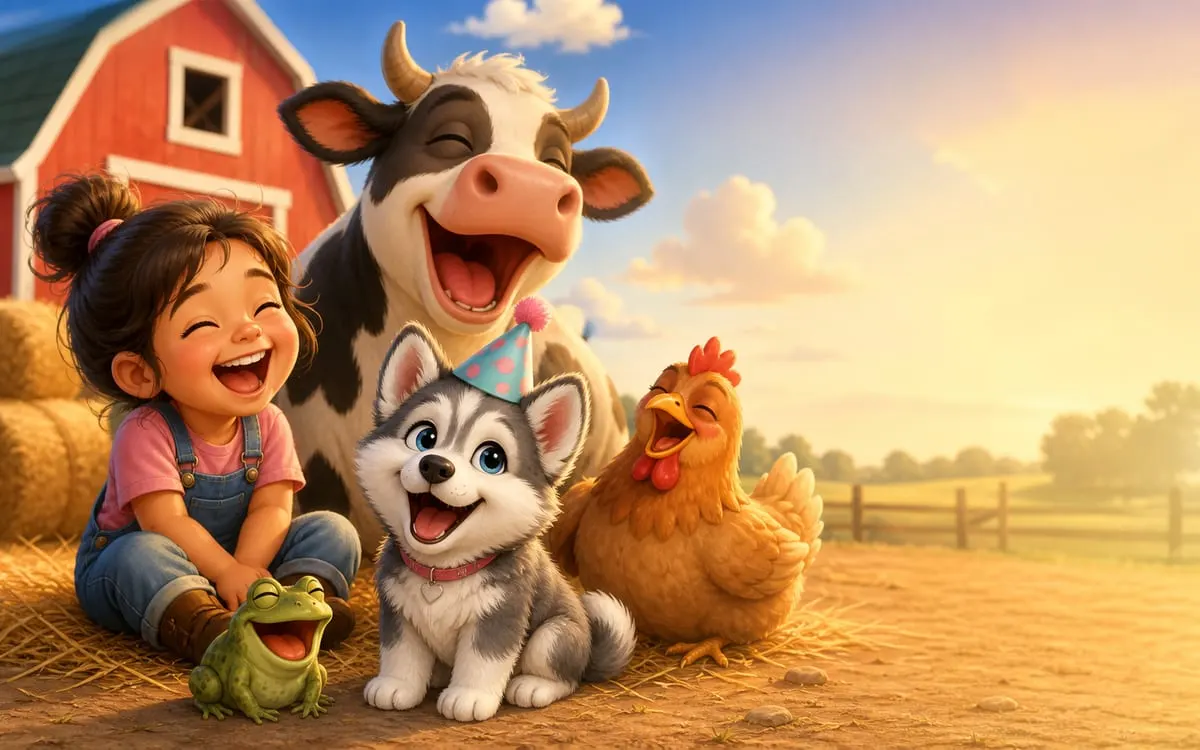
Your next adventure could be a moment together.
Now that you have met Pigúiça here, discover the story behind her world. See the illustrations, read the beginning and choose a book to share with your child, one page at a time.
Can the forest animal do it? That question brings the whole woods into your living room: the grown-up asks, the child answers with their body and finishes with a sound. Here are 12 forest animal challenges, sorted by age from 3 to 8, all short, safe and done indoors.
You only need open space, socks or bare feet, and someone nearby. Read each question in a nature-documentary voice, let your child try, and celebrate the effort. At the end of every challenge they make the animal’s sound, and that is the part everyone will want to repeat.
Before you start: safety first
The forest here is pretend. Move tables and sharp corners, clear away anything that could tip over or hurt, stay beside your child, do not let them climb on sofas, chairs or beds, and stop right away if they get tired or lose interest. Play is never a test.
Challenges for ages 3 and 4
At this age, big, simple movements work best. Each challenge lasts only a few seconds.
- Can the owl turn its head nice and slow? Sitting on the rug, your child turns only the neck to the right, back to the center, then to the left, with big round eyes, three times. To finish, the sound: «Hoo, hoo!»
- Can the squirrel stash nuts in its cheeks? They puff up their cheeks, hold little squirrel paws against the chest and take five quick steps in place. To finish, the sound: «Tic, tic, tic!»
- Can the fox walk without making a sound? On tiptoes, they cross the room slowly with paws in front, so quietly that nobody hears a single step. To finish, the sound: «Ring-ding-ding!»
- Can the deer lift its antlers up high? Standing, with open hands beside the head like antlers, they stretch up tall and then lower slowly, three times. To finish, the sound: «Mooof!»
Challenges for ages 5 and 6
Now your child has better body control and enjoys simple rules and counting.
- Can the frog hop from lily pad to lily pad? Crouching low, they take five short hops across the rug, as if going leaf to leaf, staying inside the open space. To finish, the sound: «Ribbit, ribbit!»
- Can the bat sleep upside down? Standing, with arms crossed over the chest like folded wings, they close their eyes and stay quiet for five seconds. No hanging and no flipping upside down. To finish, the sound: «Eee-eee-eee!»
- Can the wolf howl at the moon? Face tilted up and hands on the tummy, they take a deep breath and let out one long howl, twice, without shouting. To finish, the sound: «Awooooo!»
- Can the anteater stretch its long tongue? They reach one arm out like a giant tongue and pretend to fish for ants in the air, slowly, side to side. To finish, the sound: «Fff, fff, fff!»
Challenges for ages 7 and 8
Here come balance, focus and a bit of daring, still with a grown-up close by.
- Can the woodpecker keep the right beat? Sitting down, they tap a finger lightly on the palm to rhythms the grown-up makes up: three taps, a pause, two taps. Then they swap roles. To finish, the sound: «Tok, tok, tok!»
- Can the bear stand up like a person? With feet planted firmly, they rise onto tiptoes, lift arms like big paws and count to five without losing balance. To finish, the sound: «Grrrr!»
- Can the rabbit hop without a sound? Ten short hops with both feet together, so soft that nobody hears them, with hands as ears beside the head. To finish, the sound: «Nom, nom!»
- Can the ladybug stay still with her wings closed? Crouching, with arms tight against the body like wings, they freeze for ten seconds and then open their wings with one tiny hop. To finish, the sound: «Bzzz, bzzz!»
Turn the challenge into coloring time
After so much moving, children are often ready to sit down and focus. Offer one of our free printable coloring pages and ask them to color the animal from the challenge they liked best. Each colored animal becomes a trophy, and chatting about colors, feathers and paws builds attention and vocabulary.
If they want more, the free Pigúiça game runs in the browser, with no sign-up and no ads. Kids who enjoyed this format will also like our sister post, Can the sea animal do it?, and Can the dinosaur do it? to round out the afternoon.
Tips to make the challenges work
Use a narrator voice. Asking the question with suspense is half the fun, and the sound at the end is the prize.
Let your child propose. If they invent a new animal, welcome it and make it their challenge. Maybe a boar, a turtle or a skunk.
Swap roles. When the grown-up tries too, kids laugh, loosen up and ask for more.
Celebrate effort. “You tried again!” means more than “you got it.”
Do just a few at a time. Three or four challenges are plenty, and the rest can wait until tomorrow.
Frequently asked questions
What ages are these challenges for?
They were designed for children ages 3 to 8. The first four are the simplest, and the last ones ask for more balance and focus. Families can mix the groups and adapt to their child’s pace.
Do I need any materials or a big space?
No. A rug or a free corner of the living room is enough. None of the challenges use heavy, sharp or fragile objects, nobody climbs on furniture, and a grown-up stays close the whole time.
What if my child cannot do a challenge?
That is fine. Make it easier, try another animal or repeat it tomorrow. The goal is to play and move together, not to pass a test. Praise the attempt and always finish with a hug.
Your next adventure could be a moment together.
Now that you have met Pigúiça here, discover the story behind her world. See the illustrations, read the beginning and choose a book to share with your child, one page at a time.