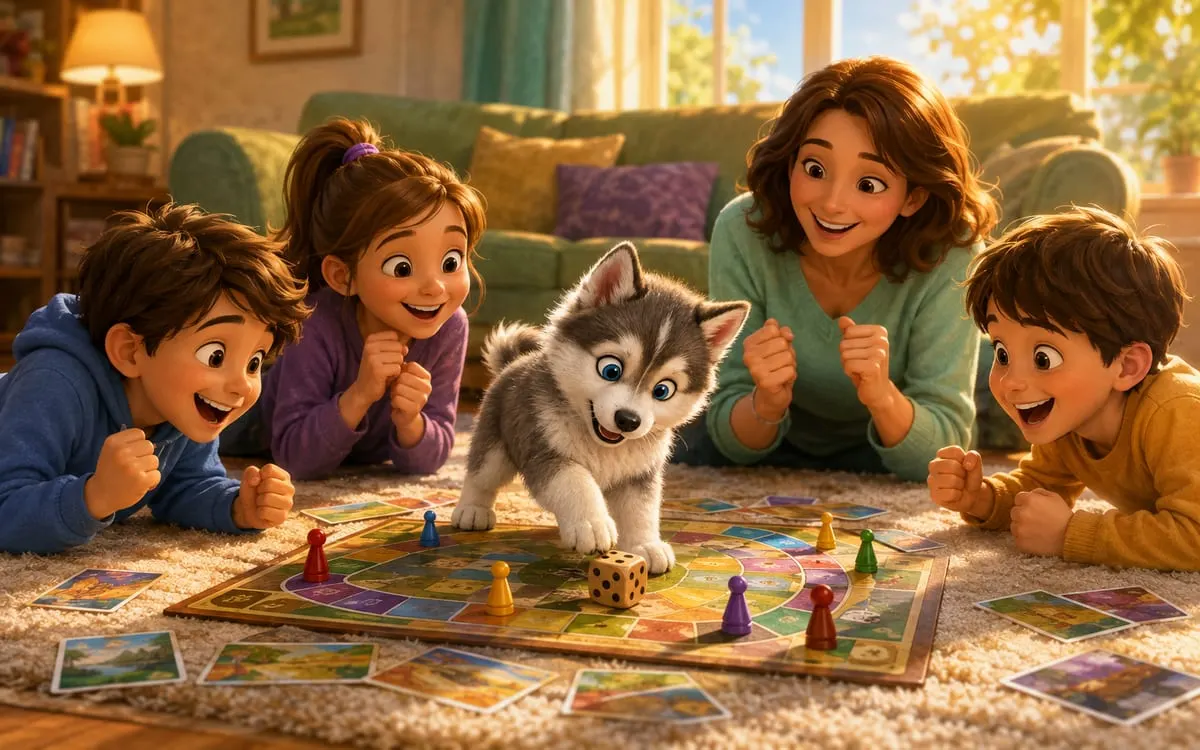
After the game, discover the story together.
Pigúiça also has an illustrated adventure to read together. Explore real pages, read the beginning free and check the complete edition if you would like to continue.
A well-chosen board game gives you hours of conversation, mental arithmetic, turn-taking and negotiation, all disguised as fun. A badly chosen one gathers dust after the second round. The difference is rarely the price: it is matching the age, the length and the kind of decision the game asks for. Here is how to get it right.
Choosing by age
- Ages 3 to 4, pure luck games: picture dominoes, colour dice games, memory with six pairs. At this stage children do not plan yet, so the dice should decide the game. Ten-minute rounds at most.
- Ages 5 to 6, first strategy: set-collecting games, races with shortcuts, rule-based matching games. This is where choosing between two moves appears. Aim for fifteen to twenty minutes.
- Ages 7 to 9, decisions with consequences: route-building, simple auctions, cards with powers. Children can now handle a move that only pays off three turns later. Chess and draughts fit nicely here.
- Ages 10 and up, negotiation and bluffing: resource trading, deduction and alliances. This is when the board becomes genuine social training.
What each mechanic teaches
- Dice games: counting, number sequence and the hardest lesson of all, not everything depends on you.
- Memory games: working memory and sustained attention. Add pairs gradually instead of switching games.
- Cooperative games: everyone plays against the board. Excellent for a child who cries when losing, because the team wins or loses together and nobody is alone in defeat.
- Bluffing card games: reading faces and impulse control. Start with short rounds and open cards while teaching.
Making the game last
- Adapt rules openly: say out loud that today you are playing with an easier rule, and agree when it will be dropped. A secret rule that lets a child win damages trust the moment it is discovered.
- Teach losing in short games: losing after ten minutes hurts far less than losing after an hour. Quick games train frustration in small doses.
- Stop before the tiredness: put the game away while it is still good. A child who stops wanting more comes back next week.
- Let your child explain the rules: to a sibling, a grandparent, a teddy bear. Explaining consolidates understanding faster than playing.
Boards and screens are not enemies, they pair well. After the match, the same child can go run, jump and collect stars with Pigúiça, the blue-eyed husky from Dogavios, in the free browser game available in 18 languages, with no install and no ads getting in the way.
After the game, discover the story together.
Pigúiça also has an illustrated adventure to read together. Explore real pages, read the beginning free and check the complete edition if you would like to continue.