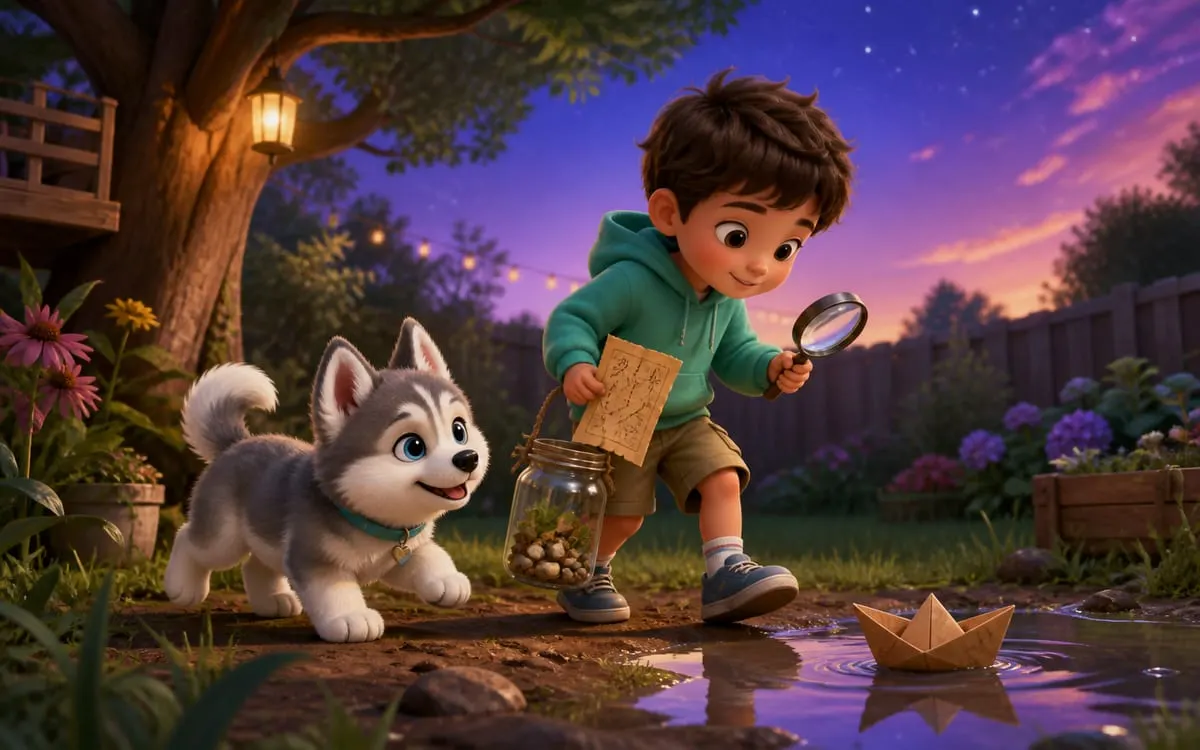
Your next adventure could be a moment together.
Now that you have met Pigúiça here, discover the story behind her world. See the illustrations, read the beginning and choose a book to share with your child, one page at a time.
At six, school gets real, reading clicks, and children start comparing what they can do with what their classmates can do. That brings pride and frustration in the same week. The best activities for this age have a visible result at the end, something they can hold up and say "I made that".
Experiments that impress
- Baking soda volcano: bicarb, vinegar, food colouring. Ask them to predict what will happen first, that's what turns foam into science.
- One experiment a week: pick a Saturday classic and keep a small notebook of results.
- Real gardening: their own pot, their own watering duty, and measuring growth with a ruler each week.
- Shadow tracking: chalk around an object's shadow in the morning, at noon and in the afternoon. Brilliant conversation about the sun.
Projects and making
- Family newspaper: one page a week of household news, written and illustrated by them.
- Comic strip: fold a sheet into six panels. The structure is done, they fill it.
- Stop-motion on your phone: figures, ten photos, a simple app. Screen time used to create, not consume.
- Their own recipe: they invent a snack, write the recipe down and serve it to the family.
- A real letter: to a grandparent, a cousin, a friend who moved away. Writing with a real purpose changes everything.
Games that train thinking
- Draughts or simplified chess: thinking two moves ahead is executive-function training that's hard to beat.
- Card games with scoring: mental addition that doesn't feel like maths.
- Secret word: you think of a word, they ask yes-or-no questions. Pure logic, zero materials.
- Twenty-minute challenge: build the tallest tower possible from whatever's on the table, against the clock.
Activities to do with friends
- Backyard club: two or three friends, an invented name, paper badges and one mission per meeting. The organising is entirely theirs.
- Home tournament: three simple events with scores written on a sheet. Winning and losing in small, survivable doses.
- Cooking in pairs: splitting a recipe in two forces negotiating and waiting. Good conflict, the kind that teaches.
- Book swap: each friend brings two of their own books and lends them for a week. Reading what a friend recommends motivates far more than reading what an adult assigns.
About boredom
When the "there's nothing to do" arrives, resist fixing it instantly. A few minutes of boredom is exactly what pushes a child to invent something. A good middle ground is an idea list on the fridge that they choose from, the decision stays theirs and you stop being the entertainment.
For rainy afternoons, Dogavios has a free browser game and short cartoons with Pigúiça the husky, if you'd rather have screen time that leaves you something to talk about afterwards.
Your next adventure could be a moment together.
Now that you have met Pigúiça here, discover the story behind her world. See the illustrations, read the beginning and choose a book to share with your child, one page at a time.